East Himalaya

Wednesday, November 21, 2012

Let there be Light


The Durga Puja Festival and the Festival of Light, Diwali has just completed. This was almost a festival month across India with celebrations, mainly at night with full lights and fire crackers. During this month long holiday many people decided to Celebrate the Festival of Light at Tiger Hill early morning. The rising sun, the lights on the mighty Khangchendzonga and a few other snow capped peaks, the music of the birds waking to the sun is no less a festival of lights and practically lights up the inside, a rare opportunity to get the real blessings. Any nature’s festival makes everyone happy, without making any difference between rich and the poor, the powerful and the downtrodden, the believer or atheist, the fair and the dark, the good and the bad. We did have many such events and traditions before, which make everyone happy, and now the time has arrived when we should try and patronize such rare activities. 


Only last week while on the speeding train through many unknown village landscapes, I woke up early morning, and peeping through the window, to my amazement I noticed there were people squatting beside the railway line for the morning clearance, which certainly is not very uncommon, but some of them speaking on their mobile during their action. Sometimes it is hard to understand, what is more important, the mobile phone or the sanitary toilets.
Similarly, many urban priorities have reached the villages. We often see that development means urbanization; and urbanization means display of resource wastage. This has even entered our villages. We have been removed from several of our village traditions. Specially waking and sleeping by the natural light, all of it mostly using more of our never ending resources like solar, wind etc, instead of electricity for lights and air-conditions at almost all working and living spaces. Our city malls are more active at night and most of them are lit up all night for reasons unknown.


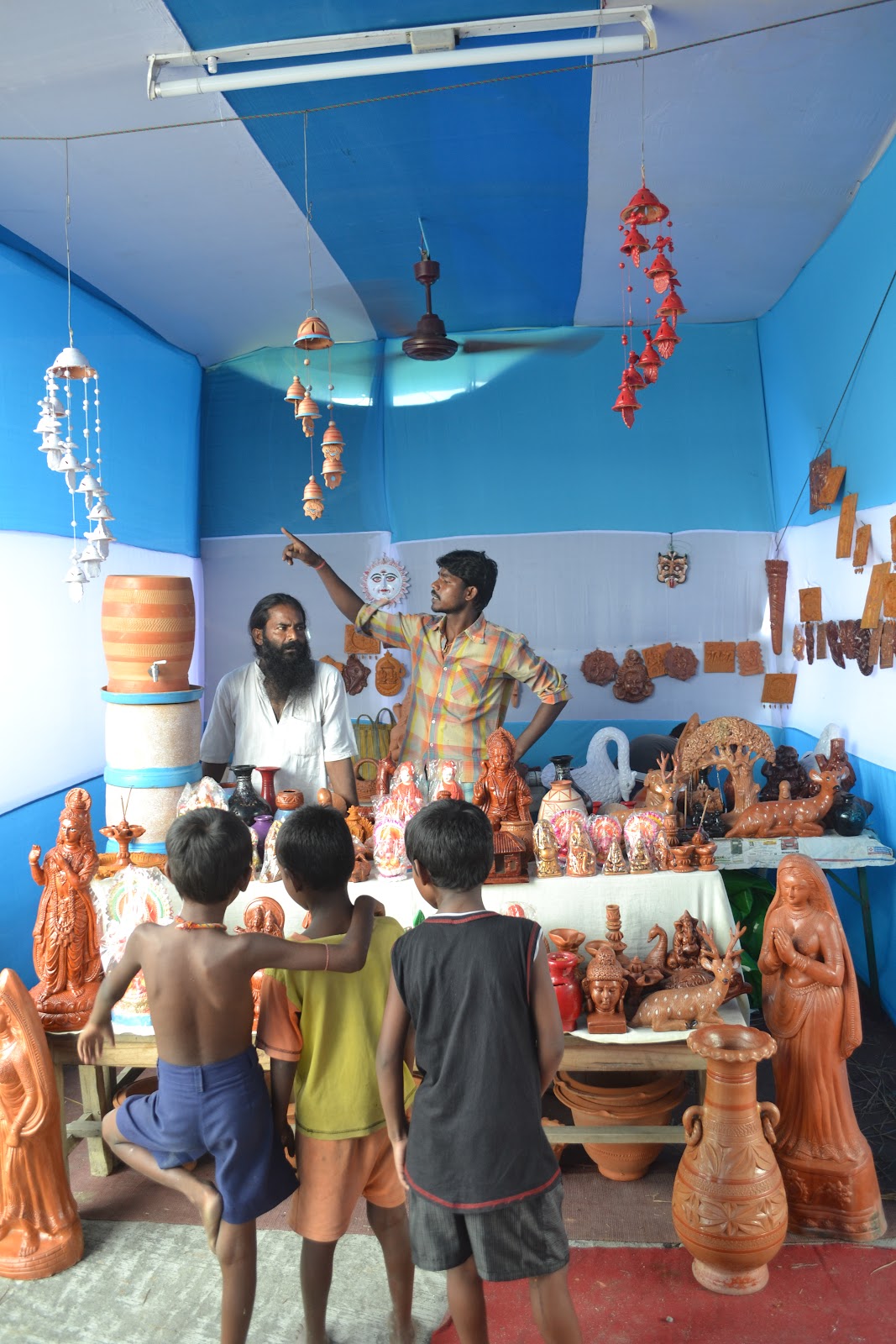
Experience their ancestors, the village mall, called HAAT, a weekly market which started on the basis of barter system between several clusters of villages and exists even today with no carbon footprints or guilt to follow. In most places it starts early in the morning, at some places a little late, but finishes by day light. Some bamboo with simple roofing plastics are used by the little bigger traders, the small village producer simply put their products on the ground for sale.
From Bamboo, cows, bullocks to fish, vegetables and tea, all that we need to lead a village life is available here. These are mostly sold by the producers themselves and they get their money directly through a process which may be termed as Fair-trade. Again these producers with the money they have generated from sales, they buy their essentials. Everything is cleared before dark and next day morning there is no trace of this big market held. This is a place for communal harmony, a people to people meeting place to know and understand each other directly.
Many of us get lost in the Malls, but can find ourselves in these HAATs, mostly called Bazaar (which is probably of Persian origin), and want this tradition to live. Hence, this initiative has been taken to put together information of Haats or Bazaars near tourist destination to enable the tourists to visit them. This will give them a better understanding of the local people, their lifestyle and their joys in the small things. These Haats and Bazaars are ‘hubs for happiness’ for all, the buyer, seller and the visitor. Please email the information about your nearest Haat or Bazaar to atishdipankara@gmail.com and the same will be updated in this blog.


Note: This logo is a copyright of the Editorial Board of this blog based publication and by no means can be used for any other purpose without permission.


Monday, November 12, 2012

Call of the Hoolock Gibbon, 10.11.12...Foundation Day


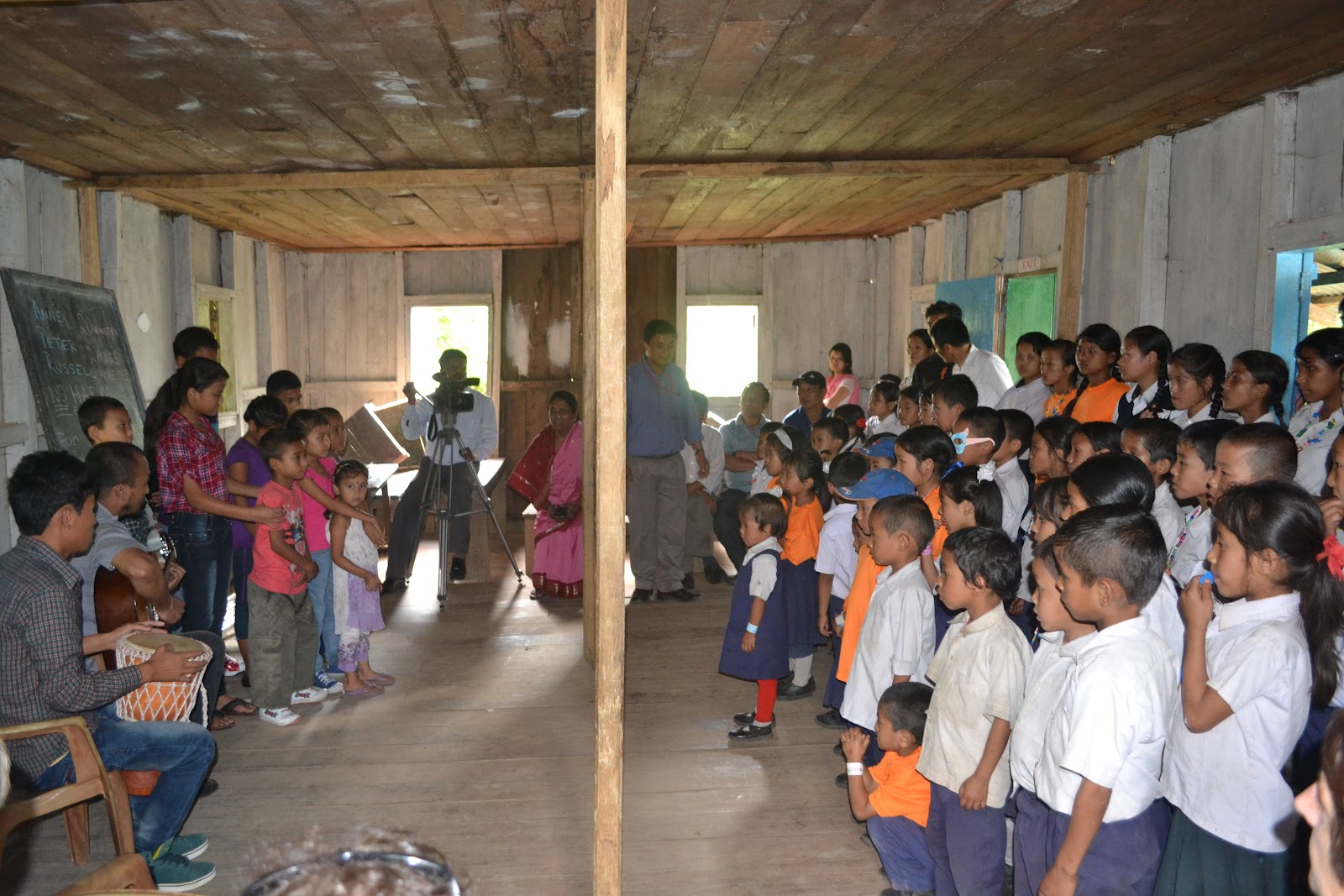
Ramchandra Chakma, a small boy of 02 years of age played in the Hoolock Gibbon habitat of the dense forested hills of Chittagong. Khatuli Village, Kalamanji at Rangamati was his house, which has almost wiped off his memory at this age of 72. He had to migrate as a young family man, leading his entire locality to the world unknown. Today he lives in 8th mile village at M’pen-2 in Namdapha Tiger Reserve with his dream, the Namdapha Nalanda Nature School. He still feels lucky to wake up with the call of the Hoolock Gibbons. 10th of November, 2012 is the 4th Foundation Day of the school. Before this, a small village shed called school was regularly washed away by the Noa Dihing floods. 


10th of November, 2008, Stefan Loose and Renate Loose, travel writers from Germany, known for their love for Asia, along with the then Field Director of Namdapha Tiger Reserve, Yogesh laid the Foundation stone of Ramchandra’s dream. A school on stilts was the dream of the village with 104 Chakma family houses, sandwiched between the flood waters of Noa Dihing and the dense forests of Namdapha, who managed to survive, because several years back, a good Singpho Chief helped them to settle down in their backyard forests, today known as Namdapha. The local people also heard about this chief from a English tourist to Namdapha, who highlighted that the kindhearted Chief has been mentioned in World War stories from the diaries of the soldiers who managed to flee Burma (then occupied by the Japanese forces) through Vijaynagar and camped in the present ‘Firm Base’ in Namdapha forests.

Today, when roots divide, religions divide, politics divide and above all borders divide, the Namdapha Nalanda Nature School represents compassion and peace, a feeling which is needed to keep this world together. This is a region of Dihing-Patkai in Northeast India, which saw regular land based human movement between the Malayan Peninsula, Yunan region and Tibet for centuries unknown. This is a region, where the main human religion is that of Biodivinity, where the humans respected the original inhabitants in this land of the Hoolock Gibbon, Elephant and Tiger, and lived in harmony. The school has been set up to nurture this culture.


On this occasion of the 4th Foundation Day, the representatives of Help Tourism and SEACOW got together with the students, teachers and the school committee members. After an aggressive flood this year, the rice in the fields looked forward to one of the best harvest (once a year). The local Government has shown some indications of upgrading this school into a primary school. With all this joy, the villagers have decided to bring back their folk dances and songs, which they have forgotten in their race of survival for the last 02 generations. It was decided that every year from 2013, this Foundation Day (10th November) will be celebrated as the ‘International Festival of Compassion and Peace’.
Today there are 48 Boys and 49 Girls as students, 03 male Teachers and we are still looking forward to have a lady teacher.
The hand pump tubewell water facility has been working well and being good drinking water, the people of the adjoining areas use the same.
The toilet needs to be upgraded as of now as the water flooding this monsoon has put them in bad condition, but are still usable as the Indian Squat Toilet is still working well.
The school committee has agreed to give 01 or 02 classrooms for nighthalt of visitors coming for nature study and community help. Also the protected campus may be used as a camping ground. The collected revenue will be used for upgrading the schooling facility. 


Tuesday, November 6, 2012

Governance and People

November 6th, 2012, Rajdhani Express: An Indian Airforce personnel joined me at Guwahati station, his hometown is in a particular remote district of Uttar Pradesh. While he was coming to take the train from his base station close to the Guwahati Airport, about 23 kms total distance to be covered; his car was caught in a traffic jam near the Guwahati University, never to be relieved. He has started about 02 hours in advance, but he could feel that he may miss the train. He got down from his car and requested a bike rider to give him a lift, who happily brought him till Maligaon. Then from Maligaon a three wheeler auto rickshaw could hardly bring him to the Kamakhya Temple entry gate point, then again a never to end traffic jam.
Again a kind bike rider, who was going some other way, but agreed to drop the Airforce personnel to  the Guwahati Railway Station, who would otherwise miss the train. When the BIKER was offered money, he gracefully refused and left for his destination. The train was to take him to Dibrugarh, from where he has to join duty at Chabua, the most important Defence Air Base Station since the 2nd World War. Often we talk about governance in Assam, but imagine the people, who are more than helpful. Traffic Jams and Water Logging are the biggest challenge of most Asian Cities today.


Just a few stations back, a group of readymade garment retailers got down at Coochbehar Station. Coochbehar is a heritage town, which still lives in the royal days with the famous Coochbehar Palace and other heritage buildings. They were returning from Delhi by this train Rajdhani, one of the most important trains which come all the way from New Delhi and travel through Mugholsarai (Uttar Pradesh), Patna (Bihar), New Jalpaiguri (Siliguri, the base for Darjeeling Hills and Sikkim), Coochbehar, Guwahati (Northeast India’s Trade headquarters) and finally ends at Dibrugarh (Northeast India’s Gateway town to Southeast Asia) after 02 nights journey. They were at Ludhiana, India’s centre, famous for manufacture of winter garments. They were discussing about the manpower crisis in the garment industry of Ludhiana, as most of the labour force is from Bihar, and the good governance at Bihar has reduced the migration of village forces from the state to other places of India where there are industries and there was a tradition of people moving to opportunistic areas to work as labour. Though Bihar historically was one of the most enlightened states, yet in the recent past Bihar witnessed the maximum migration of her people, till very recently things seems to be improving.
In the olden days, the people of Bihar and the area, presently known as Bangladesh navigated the 02 big rivers of India, Ganga and Brahmaputra and their tributaries. Till date, the Brahmaputra and some of the tributaries, which do not have much bridges, the traditional river navigation business continues and the ghats are till date dominated by these people. This reminded me of the fact that the present Sarraighat Bridge near Guwahati  had probably opened to goods train about 50 years ago from today, inaugurated by the then Prime Minister, Pandit Jawaharlal Nehru. My dad’s first posting as a Railway electrical engineer was at Amingaon, a beautiful habitat beside Brahmaputra. This area was then dominated by dacoits and mum often referred to a dacoit being my dad’s table tennis partner. He often had his dinner with my mum and dad, and this was like a Bollywood theme to me. The metre gauze train, before the Sarraighat bridge, stopped on the other side of mighty Brahmaputra (I have forgotten the name of the place) and there were ferries which brought passengers to Pandu. Pandu was then an important river port but now lost in a pocket, very close to the bustling city of Guwahati, an heritage dying a slowly.
Dad’s posting in several railway places of Assam and my visiting him during the vacations. My childhood days of learning bicycle riding and several adventures close to nature always kept Assam close to my heart. I even spent studying 02 full years of senior schooling in this state and then finally my work rooted over here. By here, I mean the seven sisters of Northeast, which was all together then called Assam. Though Assam is a world famous name, yet we do not find this name in Huien Tsang’s description. In his travels we read about a lot of places and rivers here in present Assam, but not with the name Assam. Most of the historians describe that the name has the origin in Sanskrit description ‘A-SAMA’ or undulating land, but I always feel that the name came with the ‘Tai Ahoms’. Much before the Allied Forces built the legendary ‘Stilwell Road’ during World War 2, Sukhapha, the greatest of the Ahoms, led the Tai Ahoms to this land blessed by the Brahmaputra, through this route. Whenever I eat my ‘Fish Asom Curry’ at the Malaysian Food joints, it strikes me that the name Assam originates from the term ‘Asom’, the fish curry. If one tastes the ‘Machor Tenga’ (traditional fish curry) in Assam, one will realize that ‘Asom tradition of Fish Curry’ is part of the DNA that travelled from the Malayan Peninsula.
The name Assam is so much embedded in people’s heart and mind, that my friends, the 02 brothers, Chottu and Kommet, when they fled from East Pakistan during the ‘freedom movement for Bangladesh ‘and took refuge in Berlin, they later opened an Indian Restaurant there at Berlin, called Assam Restaurant. They hardly had any idea of Assam but they kept the name because they felt good at heart. Today, this is not only a popular Indian food joint in Berlin, but a meeting place of global intellectuals with struggling people, a centre of compassion and confluence of minds who think of a world without borders.  A concept which the entire Assam with Northeast is missing, a landlocked area between South and Southeast Asia, waiting for her borders to open to the world. The way that history had shown us, this was the land of intersection of the Silk Route with its older version, the ancient Tea Route. An area which has always had its border open to the world ages ago, an area which today is the bowl of most diverse cultures.


Wednesday, October 24, 2012

The Primary Teacher


Most of you who have been to Singapore and are ‘Food Fanatics’ must be remembering the Satay, Bak Kut Teh, Char Kway Teow, Laksa and several other Southeast Asian food served in the very Singapore style. This time also on the last day, on my way back from ITB-Asia, my farewell dinner from my friends was at the usual place, East Coast Sea Food Centre near Changi Airport, one of the few horizontal corners of Singapore, with lots of ‘Chilly Crab’ and ‘mantao’. The Chilly Crab, which has almost become the ‘Host’s National Dish’ to honour guests at Singapore comes as a big portion and hence needed a walk along the beautiful East Coast before proceeding to the airport. Two small boys, escorted by a senior gentleman were taking something like a balloon, to be put together as a children’s playing item, from another gentleman. One of the small boys wanted to have it first, when the man giving it to them said ’son, you must have patience’. The small boy impatiently replied back “I have money”. The man again told him ‘but son, you must have patience’.
This was a touching experience for me, are these the values we are trying to teach our children, is this the future of our human civilization and many more questions may have come to our minds. Then where do we start working on this. In Asia, we need to empower the large rural areas; where there are still some deep rooted values and we need to start from the schools for children there. We need to let all our children of the world learn from the rural communities of Asia, where their lives are still governed by the environment around them and help the children of these rural areas feel proud of what they have and accordingly help to conserve them.
   
End of September, 2012, a group of very senior Australian teachers organized the ‘Regional Teachers Training Workshop’ at the Primary School at Kolakham (the last village adjoining Neora Valley National Park upper region), covering about 03 rural primary schools from the area. The Neora Valley Jungle Camp, which was set up to support the local primary school (Government) had already become a model rural primary school under the Singapore – East Himalaya Program for the entire Darjeeling Hill area, further enhanced by present program under ‘Growing Through Education Foundation’, with the mission to ‘Help Schools in Need’ in the East Himalaya.

Here, I had managed to introduce Deoashish, the ‘Himalayan Baul’, who had put together a few socially scattered children into a group called ‘Varnamala’. This was the first effort in East Himalaya for someone to write, compose and give music to Nepali (Gorkhali) alphabetical rhymes. Though he had gathered some popularity in the Himalayan towns of Kalimpong and Gangtok, yet I always thought that his composition was most appropriate to the rural areas of Nepal, Sikkim, Darjeeling Hills and other Nepali speaking areas of Dooars with Northeast. The introduction seemed to work and within 02 hours the small children Kolbong and Dagyong schools were singing and dancing to the tunes “Adua khaye piro mani, ama pani auncha nani...”. This is because of the fact that the words of the rhymes represented what the children saw in day to day life.
Varnamala Class (click here to watch video)


This is what education is all about, relating subjects to day to day happenings in and around and not pushing students in the artificial ambiance of classrooms and further in the digital/computer boxes making the children deaf and dumb about the environment around them. If one visualizes the ‘Gurukul’ s/he will realize that the children of all backgrounds had to go to the Guru (Teacher), usually in the fringe of a forest, where they used to be taught in the outdoors with the classroom under the tree. Here they learned all the elementary things of life. This was to a large extent adopted by Kabiguru Rabindranath Tagore for the school level, which still continues at Shantiniketan, near Kolkata.

Even at the Nalanda, Taxila and Sompura Mahaviharas (Universities), probably the first known universities of the world, the students had to go from village to village for alms or from vihara to vihara in search of knowledge, all of these were for the fact for them to understand all the levels of the society and the outdoors which the human beings live with. With the Cambridge or the Oxford Universities, the pattern changed and was much influenced by the industrial revolution, the walls around the classrooms became a must and text books, exercise copy books, pencils, rubbers, pens, ink, ruler etc all came out as industrial products, which students had to consume. The trend continues with the digital age, with the best schools to consume air-condition, laptops and internet, with digitally smart teachers who can best copy-paste the human environment and present it in the four walls.

Most of our visit to the ‘Places of God’, which is often referred to as pilgrimage, is today completed through television or on internet. The ‘pilgrimage’ is all about the ‘Yatra’ or Journey that one has to undertake to reach the place of God. The journey which makes you understand the different communities, their culture, the different forms of nature and the outdoors in general. The journey that makes you wiser in the process of reaching the ‘Place of God’. One has to travel in person and not virtually to achieve it. The five senses with the sixth support which we are born with becomes defunct without travelling and living beyond the four walls of houses, vehicles, classrooms and computers. It is, as if people have forgotten to travel outdoors, even when they undertake travel it is within such controlled conditions that there is no connectivity with the outdoors. The time has arrived, when we must strive to be a generation who will play with the clay and water to make gold from the sun. A generation who will travel outdoors for their ‘primary education’. 


Wednesday, September 5, 2012

Homestays, a tradition in East Himalaya


“Bans Paincha”, “Bans Huncha”, the mother of the house, an old women peeps out of the window and says “Paincha, Aunuhosh”. All across Nepal Himalaya and some parts of East Himalaya, when a tired traveller, not being able to pull himself anymore towards the destination, calls out from below or above a house “Can I get a place to stay”, the usual answer is “Yes, come in and make yourself comfortable”. Most of the houses in the area are lived by a joint family, where the mother, who is also the grandmother, makes the decision for the guest. If it is day time, the men of the house have gone out to work, the children at school or playing in the nearby empty space if it is late afternoon and the younger women in the fields.
The guest is greeted inside with some cool water to drink and some hot black tea and Bhuteko Makai (Roasted maize grains). He is given a place to rest and sleep towards the outside room and have to wait for the women of the house to return and cook some food for the house and the traveller. While the traveller leaves, he leaves some gifts or money for the family, which usually goes to the eldest unmarried girl of the house. This is often called locally as ‘Pewa’, where any extra money, gifts etc goes to the eldest unmarried girl of the house and the goes with her when she leaves for her inlaws after marriage. This wonderful homestay tradition has continued for ages till the time tourism in the region became a main stake.
ACT or Association for Conservation and Tourism transformed this tradition into a major livelihood for people, mainly from remote villages. Implementing model homestays through motivation camps and making conservation of the local natural and cultural resources through these tourism livelihoods have become a revolution in the region. With almost 600 member homestays, ACT has been able to give them a market linkage through Government Tourism websites and Help Tourism websites. Help Tourism has been able to attract several volunteering visitors and has established a new form of tourism in the region often referred to as ‘voluntourism’.  
Many points and policies have been discussed and been included in this blog before http://chautare.blogspot.in/2011/10/homestay-policy.html.

The 02 pictures used above are from a very authentic Limboo Homestay at Hee called Barsey Jungle Camp and the 1st picture is from Arunava Das, a famous travel writer.

.  

Monday, September 3, 2012

North Bengal Pineapple Fest, a pictorial journey

Siliguri, 01st September, 2012. Happy faces coming out with hands full of the dream fruit pineapple from this happening Pineapple Festival at Bidhannagar, about an hour’s drive from Siliguri. The 03 days first time festival in the tea district of Darjeeling is an initiative of the Siliguri MLA, Dr.Rudranath Bhattacharya, who also happens to be the Chairman of the organizing institution, Siliguri Jalpaiguri Development Authority. 

He wishes to take it to the next step of making this an International Tourism Festival bringing all the pineapple growing areas of the world together. This is a trend which was started in North Bengal, mainly in Darjeeling District, an effort to make value addition to major agricultural products like Tea, Mango and Orange by Help Tourism and Association for Conservation and Tourism. This is the first time that a single handed effort of this level has been made by any Government organization, specially in North Bengal.

 For the past 02 MCCS Gitanjali Mango Festivals, I was asked a common question by the media friends as well as the fruit loving community, “as North Bengal is the largest single pineapple growing area in India, when will there be a Pineapple Festival in North Bengal”. 
I remember from my childhood days, my mother’s family was a frequent visitor to Kathambari, a densely forested elephant area beside the River Teesta, when my mother’s Biren Kaka, he was then probably an MLA from Jalpaiguri, Mr.B.N.Katham, often announced proudly about his Pineapple processing factory for Pineapple juices, jams etc in this extensively pineapple growing North Bengal. Those were the days when pineapple was grown extensively in certain areas of Jalpaiguri and Darjeeling District.
I do not know if the factory had happened, but Dabur did come up with a factory. Gradually with time Pineapple patronage dropped and Tea replaced pineapple in several places of North Bengal. I do not know whether the process will be reversed or not, but with this Festival, it is nice to see the return of Pineapple with full respect in North Bengal.

All popular local sweets like Rasgolla, Sandesh, Rasmalai, Jelebi and Amritti are being available here at the Festival in Pineapple flavour. Even Pineapple Biriyani, Hotdogs and Pizzas are not behind at this Festival. Catfal and anaras are being sold in plenty at the festival ground and on the highway. 
Pineapple juices are a relief in the scorching heat of this season. Dr.Rudranath Bhattacharya, being a doctor by profession emphasised on the medicinal value of pineapple and said “if an apple a day can keep the doctor away, then a pineapple a day will keep your worries away”. So eat more pineapples and enjoy the 03 days festival being inaugurated today. There are several other stalls for food, handicraft, cancer relief, snake bite prevention and soil testing.

The question which I faced today “when is the Jackfruit Festival going to be held?” ___bless you dear Foodies.