East Himalaya

Showing posts with label Neora. Show all posts

Wednesday, October 24, 2012

The Primary Teacher


Most of you who have been to Singapore and are ‘Food Fanatics’ must be remembering the Satay, Bak Kut Teh, Char Kway Teow, Laksa and several other Southeast Asian food served in the very Singapore style. This time also on the last day, on my way back from ITB-Asia, my farewell dinner from my friends was at the usual place, East Coast Sea Food Centre near Changi Airport, one of the few horizontal corners of Singapore, with lots of ‘Chilly Crab’ and ‘mantao’. The Chilly Crab, which has almost become the ‘Host’s National Dish’ to honour guests at Singapore comes as a big portion and hence needed a walk along the beautiful East Coast before proceeding to the airport. Two small boys, escorted by a senior gentleman were taking something like a balloon, to be put together as a children’s playing item, from another gentleman. One of the small boys wanted to have it first, when the man giving it to them said ’son, you must have patience’. The small boy impatiently replied back “I have money”. The man again told him ‘but son, you must have patience’.
This was a touching experience for me, are these the values we are trying to teach our children, is this the future of our human civilization and many more questions may have come to our minds. Then where do we start working on this. In Asia, we need to empower the large rural areas; where there are still some deep rooted values and we need to start from the schools for children there. We need to let all our children of the world learn from the rural communities of Asia, where their lives are still governed by the environment around them and help the children of these rural areas feel proud of what they have and accordingly help to conserve them.
   
End of September, 2012, a group of very senior Australian teachers organized the ‘Regional Teachers Training Workshop’ at the Primary School at Kolakham (the last village adjoining Neora Valley National Park upper region), covering about 03 rural primary schools from the area. The Neora Valley Jungle Camp, which was set up to support the local primary school (Government) had already become a model rural primary school under the Singapore – East Himalaya Program for the entire Darjeeling Hill area, further enhanced by present program under ‘Growing Through Education Foundation’, with the mission to ‘Help Schools in Need’ in the East Himalaya.
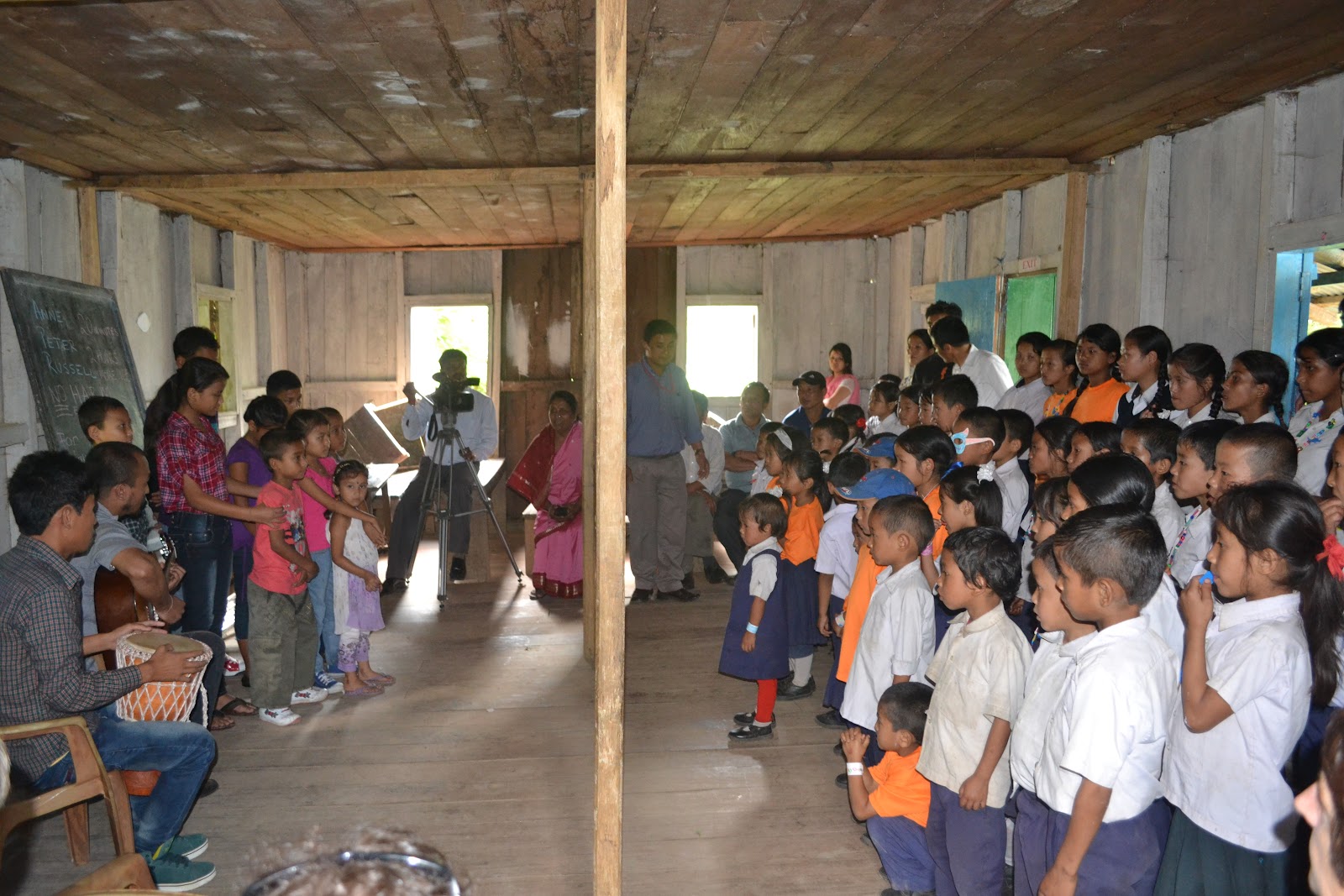
Here, I had managed to introduce Deoashish, the ‘Himalayan Baul’, who had put together a few socially scattered children into a group called ‘Varnamala’. This was the first effort in East Himalaya for someone to write, compose and give music to Nepali (Gorkhali) alphabetical rhymes. Though he had gathered some popularity in the Himalayan towns of Kalimpong and Gangtok, yet I always thought that his composition was most appropriate to the rural areas of Nepal, Sikkim, Darjeeling Hills and other Nepali speaking areas of Dooars with Northeast. The introduction seemed to work and within 02 hours the small children Kolbong and Dagyong schools were singing and dancing to the tunes “Adua khaye piro mani, ama pani auncha nani...”. This is because of the fact that the words of the rhymes represented what the children saw in day to day life.
Varnamala Class (click here to watch video)


This is what education is all about, relating subjects to day to day happenings in and around and not pushing students in the artificial ambiance of classrooms and further in the digital/computer boxes making the children deaf and dumb about the environment around them. If one visualizes the ‘Gurukul’ s/he will realize that the children of all backgrounds had to go to the Guru (Teacher), usually in the fringe of a forest, where they used to be taught in the outdoors with the classroom under the tree. Here they learned all the elementary things of life. This was to a large extent adopted by Kabiguru Rabindranath Tagore for the school level, which still continues at Shantiniketan, near Kolkata.

Even at the Nalanda, Taxila and Sompura Mahaviharas (Universities), probably the first known universities of the world, the students had to go from village to village for alms or from vihara to vihara in search of knowledge, all of these were for the fact for them to understand all the levels of the society and the outdoors which the human beings live with. With the Cambridge or the Oxford Universities, the pattern changed and was much influenced by the industrial revolution, the walls around the classrooms became a must and text books, exercise copy books, pencils, rubbers, pens, ink, ruler etc all came out as industrial products, which students had to consume. The trend continues with the digital age, with the best schools to consume air-condition, laptops and internet, with digitally smart teachers who can best copy-paste the human environment and present it in the four walls.

Most of our visit to the ‘Places of God’, which is often referred to as pilgrimage, is today completed through television or on internet. The ‘pilgrimage’ is all about the ‘Yatra’ or Journey that one has to undertake to reach the place of God. The journey which makes you understand the different communities, their culture, the different forms of nature and the outdoors in general. The journey that makes you wiser in the process of reaching the ‘Place of God’. One has to travel in person and not virtually to achieve it. The five senses with the sixth support which we are born with becomes defunct without travelling and living beyond the four walls of houses, vehicles, classrooms and computers. It is, as if people have forgotten to travel outdoors, even when they undertake travel it is within such controlled conditions that there is no connectivity with the outdoors. The time has arrived, when we must strive to be a generation who will play with the clay and water to make gold from the sun. A generation who will travel outdoors for their ‘primary education’. 


Saturday, April 16, 2011

Silk Route Journeys in the East Himalaya

The Silk Route is often referred to and being developed by UNWTO with the cooperation of 26 countries as follows
"With its richly diverse cultural assets and its wealth of natural tourism attractions spanning across 12,000 kilometres of ancient routes, the Silk Road as a tourism concept has significant potential for growth. Given the right level of investment and attention by governments, the Silk Road has the possibility to become the most internationally acclaimed travel route.
We at Help Tourism observed that India, a major stakeholder has been left out of this list. The heart of the Silk Route lies in the Eastern Himalayan Integrated Landscape and we have decided to highlight the issue through our journeys in East Himalaya along the lost Silk Route. The photographs from the first trip is being provided in this blog in two parts, but you must follow this blog for more information.
     - Photo report by Dipen Thapa


Friday, April 8, 2011

Of snows and Rhododendrons

When the whole of West Bengal is busy with the polls, mainly North Bengal preparing for the 18th, a riot of colours in white background are sweeping the higher regions of Darjeeling Hills and Sikkim. As experts have commented, this year the Rhododendron flowering is a month earlier because of change in micro-climate, but we still see the snows kissing the mountains time and again at this time of the year. I jokingly said, ‘you know Sikkim is celebrating the Rhododendron Festival closing ceremony, and you need them flowering’.
A team that went on to find the trails of the Red Breasted Hill Partridge, a species which is in abundance in the Singalila Ridge dividing Nepal with India in the East Himalaya said that they were astonished to see all the celebrity species of the Pheasants in the fog filled Ridge. The last 10 years of reporting by nature lovers show that the general awareness about nature conservation among the people living in the Darjeeling Hills and Sikkim has increased and it is believed that ‘community based tourism’ has played the positive dynamics.
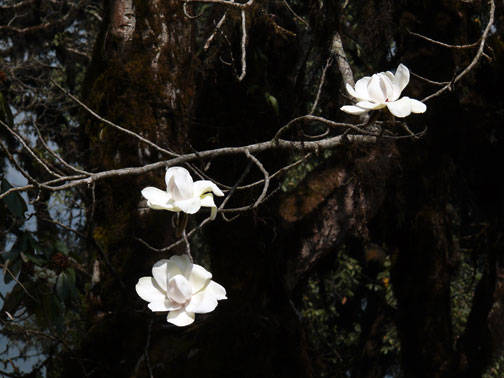
The exams in schools throughout the country are almost over and it was time for the domestic tourists to flood the area to enjoy the snows and all kinds of flowers (Red, White and Pink Rhododendrons, Primulas and many other wild Himalayan flowers). Every year I remember the tour leaders from Help Tourism lead ‘flower fanatics’ from UK, Netherlands, New Zealand, Japan, Singapore and Australia. Singalila National Park, Neora Valley National Park, Barshey Rhododendron Sanctuary, Khangchendzonga National Park and Singba Rhododendron Sanctuary are some of the places which house the Himalayan Flower Hubs.
Rhododendron is revered as one of the oldest flowering trees and the popular belief is that the Dove from Noah’s Ark had returned with a Rhododendron sprig. I know of the Help Tourism research team which keeps track of all the flowering areas of East Himalaya, specially the hidden secrets of Bhutan and Arunachal Pradesh. I have seen 08 inches flowering plants to big flowering trees of Rhododendrons all flowering between March to June. The later flowering towards June is mainly in higher altitudes on the shrubs and is complimented with monsoons and leeches.
Rhododendrons always remind me of my days in Pelling and West Sikkim in the early nineties. The Sikkim Tourist Centre had just started and I spent months with Sanjib to set up the first community based tourism infrastructure for West Sikkim of which I hardly had any idea, but I travelled widely throughout the district to motivate people. This is when my mother often visited me to help training in the kitchen for food production in the Roof-Top Khangchendzonga restaurant. She had gone on a trek to Barshey and that was the first time I heard of the blue/purple rhododendron that she had seen.

                                                        - Pix: Heerak Nandy