
Chautare are the benches up in the East Himalayan villages which are resting places on trails dedicated to ancestors and relatives who are no more, where discussions happen, specially stories from present, past and future...
Friday, August 17, 2012

Monday, August 6, 2012
Kolkata Taxis

Kolkata, 04th August, 2012. Santosh Paul was
devastated by the Teesta floods of 1968, his ware houses were all gone, so were
his trucks and the wooden house 1st floor was miraculously floating,
but the ground floor with all valuable storage was fully underwater. All he
could manage is to shift to Calcutta with his wife, 03 sons and an unmarried
daughter, find out a rented house and start everything afresh. It was not easy,
from a roaring 03 generations business at Jalpaiguri, shifting to Calcutta with
almost nothing but some values. As he was always with business, he wanted to
start as an entrepreneur. He tried his hands-on on everything which was honest
and respectable, but in vain. With 03 sons and a daughter still studying he and
his wife smilingly faced the crisis with full surrender to Mother Goddess Kali
at Kalighat temple.

The day came when there was a good person who wanted to marry
their daughter, but then he wanted that Santosh should speak to his relatives.
Happy Santosh and one of his neighbours in confidence went for finally fixing
the dated with the ‘to be grooms’ relations and they hired a taxi as they had
to buy sweets and carry them all the way from the south to the north of
Calcutta. After reaching the relations, there were some hot talks as there was
economic difference between the families and the relatives wanted the marriage
should be in the traditional way with all celebrations and formalities. The
taxi had already waited long and the Punjabi (Sardarji) driver was not very happy.
On their way back, when the neighbour and Santosh was discussing the issue in
details, the driver overheard. After they reached home, the Sardarji driver
refused to take the rent and offered to give Santosh a few thousand Rupees for
his daughter’s marriage. He also came for the marriage.
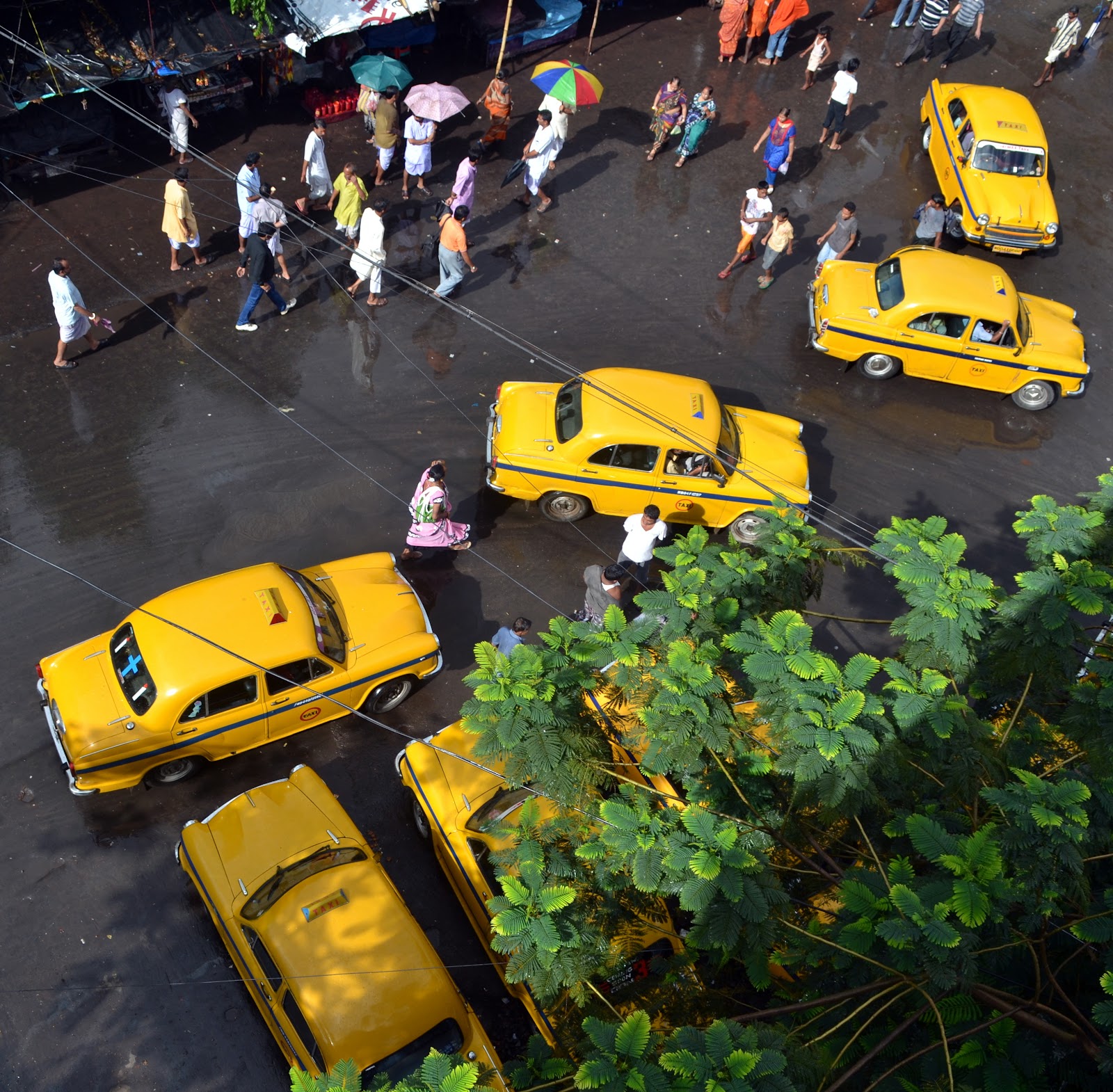
Like the London cabs, the yellow cabs of Calcutta (now
Kolkata) also are a legend to the great city. Every cab and the driver have a
story. Day before yesterday, I had to travel from North to South at Calcutta
and I was talking to the elderly driver of the taxi, Bhupen Singh. For more
than 20 years, he had driven a private car of a corporate head, who after his
retirement went back to Bombay (now Mumbai) and offered Bhupen to go with him.
Bhupen was attached with this city and wanted to stay back. The retired
corporate man gave him some money and organized a bank loan for Bhupen to buy a
taxi. Now, Bhupen is a proud owner cum driver of his taxi and is probably one
of the most reliable and decent persons I have met. He along with three of his
friends after months at Hazaribagh jail (for being a part of Jayaprakash
Narayan’s movement in Bihar), were released with a payment of Rs.60/- each for
the labour which they had given during their time in captivity. This was the
month of September or October, but time for Durga Puja. The 04 young men
sometimes in 1972, decided to go to Calcutta with the Rs.60/- and see the Durga
Puja celebrations. The 03 friends returned to their village in Bihar, but
Bhupen had already fallen in love with Kolkata and decided to stay back. Today,
he has bought an apartment for near South City Mall for his family and his 26
years old son works for an IT company. Bhupen is proud that his children are
more fluent in Bengali language than Hindi. Bhupen can be contacted at
9331374031.

Calcutta, like many of the cities of the world is a
destination of opportunities and many youths come here to live their dreams.
Till the time they do it sincerely and honestly, the city will remain a better
place to live in and visit. Unfortunately, the picture is not as rosy; there are
people who want to be rich overnight by cheating others or by irresponsible
actions. Recently, as I had reached the Sealdah station early around 6am by
Darjeeling Mail, there were several yellow taxis, but hardly any to serve the
passengers in the queue. A policeman was running around the place to force the
taxis to serve the passenger queue, the taxi union members were sitting idle at
the pre-paid taxi booth and a bunch of drivers were trying to woo the
passengers in the queue asking for double fares. The issue did not end here.

I am not always comfortable in big city ambiances and I had
to deliver a ‘Rakhi’ at a place, of which I had a written address, before I
could reach my place of stay. The yellow taxi driver seemed to be a sober and
friendly man and when I requested him to take me to the said address as I was
not well acquainted with that particular part of the city. Immediately, he did
something with his meter which jumped units. After I reached the said place and
asked for the printed receipt, he said that his paper was finished. I asked for
the rate card, he said as the rates have changed, I have to pay him 50% extra
after doubling the Rupee numbers shown in the metre. As this was a remote area,
there was hardly anyone in this morning hours to enquire. I paid him. As I
reached the contact person, who lived a little inside from the motorable road,
I understood I was wickedly cheated. I remember a part of the taxi number WB ?
E 7379. I was not unhappy being cheated, but I was worried to where this great
‘city of joy’ was leading to, a city which boasts of being one of the most
friendly cities in the world today.
Wednesday, August 1, 2012
Jim Corbett, May his dreams return on this Day

Ranajit Mitra, popularly known to North Bengal as Khokada, has long been taking the responsibility of implanting nature interest among the more younger generation for almost 04 decades now.
He has always referred to Colonel Edward James "Jim" Corbett as his metor and considers him as one of India's greatest conservators, who could not be understood during his time, but all his words have been proved to be true with time.
He insisted to see his 'Guru' as a part of this blog and hence this article may be considered as the "Tribute to the Guru" and an appeal to the world to save the last bit of nature left by him 'Rudraprayag'.

Siliguri, 25th July, 2012: Queen Elizabeth II
recently celebrated her 60 years of Queenhood. But when was declared the Queen
of United Kingdom, at that moment she was on a tree top in Africa with none
other than the Great JIM CORBETT, who mentions in his diary...’a princess
came and a queen departed...’.
25th July is the birth anniversary of this Great
Naturalist, whom many people remember as a hunter, but he was not one of those
trigger happy men, but to us, the people of India, he will always be remembers
as the one of world’s greatest naturalists, for whom India’s forests were his
first love and life forever.
Corbett, so many years ago realised that the Forests of
India and her treasured wildlife will be in a critical condition. The
politicians, naturalists and scientists of that time failed to understand Jim
Corbett and his philosophy. He had then made his forecast about the loss of
tigers and other invaluable species of this land, about drought and floods...
We still have time to pay our respects to this Great soul
from the core of our heart through the right actions of protecting our last
natural habitat which we still have in this country. We do not want any further
denudation of our forest cover in the name of development like hydel projects,
urbanization etc, after effects of which is unknown to us and our future
generations.


Sunday, July 22, 2012
Of Monsoons and Floods

Thursday, July 19th, 2012. Siliguri. Many of you
who read this blog may not have access to some of the news from this part of
the world, the Northeast India with North of West Bengal, a region with 98%
international borders and 2% with the own country, India. As soon I was
reaching Siliguri by train today morning, I caught hold of some of the local
dailies. The news about the devastating rains dominated the newspapers like
every monsoon season, this year specially could have been one of those heavy
ones, but I also read very interesting news, which I would like to share with
all of you.

There is a small locality market or small town surrounded by
tea estates in the foothills of Bhutan Himalaya called Nagrakata in western
Dooars. Closeby, is the almost unknown village of Khayerkata on the banks of
Kuchi Diana River. This river is easily crossed on foot, cycle or car in any
season except monsoon. The recent rains have also broken the only culvert on
this tiny river. A local village lady, who was pregnant had labour pain, and
inspite of the ambulance reporting from the nearby health centre, it could not
cross the river to bring the lady. The local villagers tried their best but
could not cross the river. Finally, she was taken back to her house, where with
the help of the village ladies she gave birth to a baby girl. The condition of
the mother was serious, and she with her baby were finally carried across the
Kuchi Diana River by 02 Kunki Elephants, Surya and Fulmoti to the ambulance and
then to the Sulkapara primary health centre, where they have been reported to
be safe. The 02 trained elephants from Garumara National Park are the only hope
now for that area to carry relief, cross school children across the Kuchi
Diana, who would have otherwise missed their school this whole monsoon.
We are still happy with the rains, if we do not have the
magic monsoons in the Indian subcontinent, life and food in most parts of the
world would be lost. Most scientists refer to the reducing monsoons to be
responsible for the end of the great Indus Valley Civilization. The drying of
rivers, which are mostly rain fed and partly glacier fed, live with the
monsoons. These rivers create the habitat to sustain life and finally
civilizations.

Our rivers in the foothills of the Himalaya in Northeast and
North Bengal are often flooded every monsoon season. At certain intervals of a
few years, the Indian Summer Monsoon Rainfall (ISMR), as it is technically
called is more than the others inbetween. This year the end part of June was
furious, the last it can be compared with 1998 monsoons. All small rivers and
rivulets meeting each other and flowing into each other, creating a mega flood
condition in the Brahmaputra valley. For people who live in urban areas are
frustrated with the rains, making their lives difficult. There is hardly any
connectivity of their lives with the rains directly. For the inhabitants of the
villages and the forests, the rains are the other names for life. The
biodiversity and agriculture of this region is dependent on the rains.
Asit and I made it a point to cover the Mighty River
Brahmaputra for the last 10 days, mainly the protected Areas connected to the Brahmaputra
valley. Help Tourism and friends have built a school for children at 8th
mile near M’pen at Namdapha Tiger Reserve, mainly because the temporary school
beside Noa Dihing river was taken into the river every monsoon, hence a
concrete base building on stilts was needed (please see http://www.helptourism.com/blog/namdapha-nalanda-nature-school-an-act-initiative/).

We had bought a few mangoes for the 120+ school children; they would hardly get
any in this remote area. As all of them are Buddhists by belief, the local legend
that they believe in the community, that when you go to heaven after all your
good deeds, you will be received with a mango, and also that the favourite
fruit of Lord Buddha was the mango. It was raining like mirror that day and inspite of having a 4 wheel
drive Sumo from Miao, we could not cross the M’pen nala. There was no way, we
could walk across as the local people feared that the flash flood would take us
away. There was not enough time to contact the forest Department elephants. We
waited the whole day, knowing that the children will be waiting for us at the
school, neither could the teachers reach us, nor we could reach the school. It
was only 02 days later that the young teacher Sanjay managed to contact us and
we told him that we had left the mangoes with Phupla at Miao. Another senior teacher,
Suryamoni had picked it up.

The next continuity was to Dibru-Soikhowa National Park and adjoining
areas, including Padumoni Sanctuary. We were sad to hear the news that only a
few days before some youths ventured into the DSNP and brought out some dead
deer and the same was not reported to the Forest Department. It is every
monsoon, when the rains are extremely heavy, the animals assemble at the high
areas of the National Park (which is common to a few Pas in Assam) and this is
a good opportunity for the poachers, who wait for this time of the year to take
on them. The cattle from the islands are shifted to the mainland before every
monsoon, but their wild counterparts have their own surviving spirits. Because
of the heavy rains we stayed at a very interesting place known as Padmini
Resorts, which has easy access to the Protected Areas and also Tea Garden based
activities. It is from Vicky, the local tea garden owner, we learnt that the
low monsoons in early June has given low crop, but the heavy monsoons now will
give good quality tea this year.

We went on further downstream and tried to reach the Dihing
River Camp, but for the Dihing River floods, we could not reach the camp. The men
of the camp came to see us at the Ranga-lau Bazaar near the Gammon Bridge on
the National Highway, all of them, Prashanta, Dulal, Bittu and others who were
happy because they felt that this flood will give them better crop as this will
leave their lands more fertile. The Dihing river here falls in the Brahmaputra
not far away from the camp and a new bridge, Bogibill which is being built here
on Brahmaputra, only the tips of the pillars are visible. As we talk to the
elders at Sepiakhati village, they tell us how they took their vegetables and
paddy up the Dihing River to the Buddhist villages upstream. They also often
heard from their grandparents about the tantric monks with magical powers, who
came from the Brahmaputra in boats and traveled upstream on the Dihing River.

We then advanced toward Majuli through Nimatighat to find out
about the situation of our friends at Majuli Island, the administration had
ordered only 02 to 03 ferries a day and we did not want to take up the space,
which were local rations and relief, and hence we moved on to Kaziranga
National Park. We went on the roads which were flooded, mainly on dates between
26th to 29th of June, we found a young Rhino foraging close
to the road. We have to understand the fact that if the Kaziranga does not
flood periodically, the wetlands, which dominates the landscape of Kaziranga
will not be replenished, and the habitat will no more be suitable for life. The
nature had accordingly provided with highlands which continued to the Karbi
Hills, and we as humans have closed all passages with Tea Gardens, villages,
oil and electricity establishments, security camps and ofcourse the numerous
hotels and lodges. It is mainly the road, the National Highway which has become
a barrier for the animals to move to the highlands during floods. Still things
carry on; the villagers along with the forest Department make every effort for
safe retreat of the animals in danger. The lodge manager was describing that
during his return from Guwahati during the high floods, a row of cars and
vehicles were stuck up after the Shiva Mandir. He got down from his car and
walked ahead and to his wonder found a middle aged village couple rescuing a
drowning deer from their fishing boat. All the car passengers who witnessed
this act were so moved that the couple was rewarded with a few thousand rupees
instantly.


We drove a long distance along the North Bank to Manas
Biosphere Reserve, where we have been long involved in channelizing the post political
insurgency youths to local conservation and tourism, a process to establishment
of peace and bringing the World Heritage Site out of the danger tag. We were
worried because the animal sighting in the past 02 have increased, including
that of Bengal Tigers, Black Panthers, the reintroduced Rhinos and more. Our
members of MEWS were doing good work, the tourism initiative there has enhanced
the conservation process. Though it was heavily raining, Manas seemed to be
under control and animals moved around quite safely. Manas is a part of Eastern
Dooars or Assam Dooars. There are several PAs all along Western, Central and
Eastern Dooars in continuation with Bhutan, all formed mostly on the flood
plains of the Himalayan riverine system. The unique diversity of habitat from
grasslands to high forests has become the home for many endangered and
important animal species. These areas become susceptible to massive felling
during the monsoons. The monsoon method of ferrying the illegal timber is
through the flooded rivers, locally a practice called ‘chali’. Along with several
volumes of drift wood, illegally felled trees are also collected at villages
where roads and rivers meet and finally sawed illegally in mills or temporary
set up manual sawing systems.

Forests or wildlife have always been the sacred resources for
the communities of the present Indian subcontinent before the influence of the
industrial revolution. The commercialization of the natural resources is hardly
a 200 years history which has marginalized the great culture of ‘Biodivinity’
in this subcontinent. This region of Dooars was so rich in timber resource that
the British Government in India established railway lines to bring out the
timber. We decided to visit Jogikhopa, once a forest area with caves which were
the practicing homes for the Tantric Yogis on the Brahmaputra. Often when
traders passed on these routes saw the Yogis crossing the Brahmaputra on foot
with a tiger or elephant following them. All these places have been touched with
so called modern development, centres for transhipment of natural resources,
but still carry the memories of our eternally developed past.

Saturday, June 30, 2012
Atreyi River, Journeys from past to present


Once upon a time there were 03 major rivers in the present area of North
of West Bengal; Karotoya, Mahananda and Atreyi or Mahananda often alternated
with Punarbhava. Waterways were then the way to civilization and the connection
to the world. The rivers here were time and again related to the legendary
river Teesta of this region. Teesta has always portrayed herself as an young
and dynamic even in her short span and never wants to grow old by flowing in
the same course. According to documentation in the several Gazettears and other
historical documents of the last two and a half centuries, Teesta (Tista) has been shown parallel to River Ganga in the
map and finally meeting Ganga through the 03 channels Karotoya, Punarbhava and
Atreyi through Mahananda at Hoorsagar near Gwalandar till 1787, when the great
flood changed the complete river map, where it falls in the Brahmaputra (Jamuna
In Bangladesh) now. Teesta has created havoc with her floods in 1922-23, 1948,
1950, 1952, 1954 and 1968, the last that I very well remember of and deal with
later. Atreyi today flows in and out of India and Bangladesh in a very
interesting manner along with several rivers of the area Nagor, Sudhani, Kulik,
Bina, Tangon etc which were all navigable rivers of the then undivided Dinajpur
Kingdom/Estate.

Basanti Paul, my grandmother (mother’s mother) was born in
Thakurgaon (the place from where Punarbhava originates now from the Brahmabill
or Brahman pukur). The first journey she took was for her marriage on this
Punarbhava River from her father’s house at the age of 11 and went through
Gangarampur, on the River Atreyi, then she followed to her in-law’s place in
Jalpaiguri town. Travelling through the Teesta River, she finally entered
Jalpaiguri through the River Karala. At Jalpaiguri I spent most of my childhood
listening to her river journeys and also the stories of the river journeys that
she heard from her Father about the traders. These rivers stories created
something inside me which always attracted me to visit the lands she talked
about.


I recently had an opportunity to visit the Indian side of Dinajpur with
my friend Samarjit, who was born here in his maternal grandfather’s place
sometimes in 1950. He had fresh memories from atleast 50 years ago. His
grandfather, Dr.Jagadish Chandra Sengupta was the Doctor of the Dinajpur State
Dispensary at Raiganj. He enthusiastically showed me his childhood place and
all other places which he very fondly remembers. Raiganj then had a port on Kulik
River which brought in traders from different parts of the subcontinent. He
showed me the Bandar (port) Kali Temple and remembers the priest of that time.
He asked for his sons and also asked the neighbours of the temple if the sons
still continue to be priests in the same temple as their father.

He then took me to his best friend of his childhood days, Babloo
Deshmukhaya, who runs the same grocery shop which his father ran. They talked
for hours about the good old days, their love life, their small adventures and
so much more. He gifted us with the local variety of rice, Tulaipanji, several
kinds of pickle (some of which Samarjit loved in his childhood days) and lot of
memories from the past. Here they discussed about the Bhopalpur Rajbari
(Palace) and knowing my interest in heritage told me about them.


I knew I had some family connectivity with them, caught hold
of the number of the present Prince, Partha Roychowdhury and managed a
breakfast with the family at the palace for next day. The whole family greeted
Samarjit and me as special guests. Though the present democratic status of
India does not recognize the royalty, yet the existing palace building, the
interiors, the estate and the hospitality reflected the heritage, the royalty. The
exact date I have not noted, but it was Partha’s Great Grandmother Rani
Durgamoi, who with her son, Partha’s grandfather, the then very young Bhopal
Chandra, then shifted from the family at Churamoni Estate to this place under
Birghoi Gram Panchayat. Bhopal Chandra, as he grew up, his capability to keep
up with the then British Raj, his services to his subjects (praja), his
connections with the Congress party and his intelligence gradually made him the
people’s king. The palace became the Bhopalpur Rajbari, presently 11kms from
the town of Raiganj. Partha’s father, King Shibaprashad, who is now a simple
man, tells stories about the Royalty.

Almost around the years after Independence, when the Royalty
was already gone, the King of Dinajpur had visited Raiganj, he called on young
Shibaprashad as Bhopal Chandra had already left this world and told him that he
wants Shibaprashad to buy his car at 1 Rupee 25 paisa, as he would not give it
free to a Royal family and he also would not sell it beyond the royal families
at any price because it will down show the royalty of the car. Inspite of
inheriting his father’s 04 cars he was forced to take ownership of the 5th
car. He told about how he killed the huge leopard in front of the palace gate.
He also told about how he helped the District Collector in his hunting trips.


The forests of South and North Dinajpur Districts in the
state of West Bengal in India are almost gone. Hardly there is 8% of weak
forest cover, which is very less compared to other North Bengal Districts like
Darjeeling and Jalpaiguri. Still some activists like Tuhin Subhra Mondal, a
school teacher at Balurghat continue to help conserve these last patches.
Samarjit and I were staying at the Government Tourist Lodge beside the Kulik Bird
Sanctuary in Raiganj. The open bill storks had already started with their
courtship. The birds were carrying fresh twigs to build nests. Next few months
will be really busy here for the birds, their children, their care and the
noise. When Tuhin heard that I was here, he made it a point to show me his
favourite places. We visited the Sarengbari Eco-Park, Dogachi Reserve Forest, Danga
Reserve Forest (Raghunathpur), Bangarh Ruins and some rivers.


The sight of the Bangarh ruins immediately took me to my days
following the Karotoya River in Bangladesh and finding the most interesting
Mahasthangarh, the ruins of the great kingdom. Not very far away was the World
Heritage Site, Paharpur (Sompur Mahavihara), one of the most important Buddhist
Universities which was directly linked to Tibet. I almost forced Tuhin to take
me to the border town of Hili (about 25kms from the learned people’s town of
Balurghat), the Paharpur site being hardly half an hour driving distance from
here. It is unfortunate that I could not cross across without a visa and make a
short visit to Paharpur. The border had divided families, people from 02
countries were standing across the fence, asking about the friends and
relatives, sometimes just clicking each others’ photograph on their mobile
phones to take back to their families. Only if there was a visa at border.

Tuesday, June 26, 2012
The Teesta Herders

In the Indian subcontinent cattle herding (mainly
cow/ buffalo/ sheep/ goat/ yak) has been popular and rivers have been the life line
for the herders. Herding is such an important livelihood and culture that Lord
Krishna has been depicted as a herder, who spent a major part of his youth
beside River Jamuna. Agriculture comparatively has been attached with less
glamour and was put on to his brother Balaram (often referred to as Haladhar,
the bearer of the plough). As we culture the life and legends of Lord Krishna,
we will come across thousands of stories through religious talks, songs and
descriptions of the herding life of the Great God, who is the reincarnation of
Lord Vishnu in Hinduism.

Teesta has been no exception. The lower stretches of Teesta
(in the plains) and also the areas of River Brahmaputra were known for their
‘BATHANS’. The herders had to camp in the river islands, often far away from
their home. In isolation, a small group of herders reared their cattle and made
all possible products from their milk. They came back home to their families
for a small period in the monsoons, when there was enough fodder for the cattle
in the village and also that the river island would have drowned. Some of them
were days away and some just a day out. It was always the more daring,
exploring and bohemian youths of the village who would take to herding and the
entire village or landlord or king would leave their cattle to them. There were
all kinds of stories which built up with the herders during their journeys; adventurous,
legendary, sad, romantic and happy. They had their own stories from the
grazing/pasture lands. They were talented with their song and music, many of
them which they composed and many more which they collected from faraway lands.
Even the village had their own songs and music for them on their arrivals and
mainly departures. A whole school of song and music grew up around them, often
referred to as Goalparia and Bhawaiya in the Teesta and Brahmaputra plains, the
songs of the ‘Mahishal’ and many more.

The present situation is fast changing, the pastures are
becoming permanent human habitat, some develop into forests being designated as
state or central Government Protected Areas which are often out of bounds for
adjoining villagers, the present situation do not allow the herders to venture
faraway, they prefer to day herding from their villages. During my visit beyond
Mekhliganj, the last border post of the BSF towards Neelphamari-Bangladesh,
there are a few villages and in the river is the ‘Charland’ (river island),
where again there is a BSF post now (a well established security system which
has stopped crossing over across the borders). The herders from Bangladesh used
to frequent this area in the recent past for the good quality fodder grass for
their cattle. Now this is exclusively daily used by the herders from Raipara.
Every morning the herding lot of the village get their cattle counted by the
BSF men and return with the same before sunset. Most of the residents of this
village have lost their fertile agriculture lands in the River Teesta, some of
them still continue to be herders, swimming to the grasslands in the river
islands everyday with their cattle. 52 years Dinesh Rai, one of the most
elderly herders, who has about 07 cows of his own, but herds the cows of his
neighbours on a verbal contract basis along with 35 years old Shibkumar Rai and
a handful of still younger herders herds about a hundred animals every day,
simply by swimming across the river. They cross miles in the river with these
animals. This is an unbelievable sight for anyone to witness.
They all have a hard life. Other youths whose families have
lost their agriculture lands in the River and many who cannot take the
challenge of herding have migrated to nearby urban areas, mostly to Siliguri as
rickshaw pullers, carpenter helpers etc, and are seen to be economically doing
better than their adventurous and enterprising counterparts in the village. The
livelihood and romance of herders still continue, the songs are still sung and
Teesta is still prayed and respected as the Teesta Buri (The eternal mother) of
the Teesta communities.

The story of the Teesta herders are not only in the lower
stretches, but also in the high Himalaya, the areas which form the headwaters
also witness the culture of the herders, here they are known as ‘GOTH’ and the
herders as ‘GOTHALA’, very respected in the Himalayan society. In these
highlands it is mostly the yak and sheep. Again the borders and the
imperialistic forest and wildlife management institutions are bringing about a
slow death to this culture. Most of the trade routes of the past were based on
these herding trails, many of which are today trek routes of tourism
importance. At Mangan, the headquarters of North Sikkim the legend of the 16
year old Lakpa Lepcha warms the place.
Gurung Daju, the famous herder from Naga village has adopted
the 02 years old Lakpa and carried him along the ‘Gothala Route’, a route which
is followed in the high Himalaya depending on the season, snow and available
fodder with few camps along the route. The Gothala Route from Mangan starts
from the nearest camp at Gurung Daju’s village, Naga Gumpha, Naga Tar, Kukhre
Orale, Borsardam, Toshar Lake. Lakpa Lepcha, who has inherited this route, at
16 years he sometimes is all alone with the animals. He has this magical power
of getting together his yaks with his songs. Lakpa tells the stories of the
flowering valleys of July-August, the snow fairies of November and the water
Goddess of April. All herders along the Teesta River have their experiences
with Nature God, the emotion of born traveller and the spirit of the true adventurer.
Wednesday, June 13, 2012
Teesta, the Grandmother's Story

Kamalika, an energetic and young journalist from Kolkata, India set out to find the story of Teesta. There are few people who are biased about Teesta and she is one of them, grieved with the loss of her beauty due to ecological disturbances.When she reached home, she found out that there were more stories at home from her 86 years old grandmother.
Kamalika's email: kamalikasengupta90@gmail.com
Thakumar Jhuli Part I
86 years old Bina Sengupta sitting in her dingy
south Kolkata residence still remembers her childhood days in Rangpur,
Bangladesh. She still believes that Rangpur is the best place on this earth.
From Elephant and horse rally in Tajhat, a palace in Rangpur which was then
British administrative office, everything became alive as this Octogenarian narrated
her story. Bina was fondly called Binu and she had two sisters and two
brothers. She was the youngest and that is why she was notorious and the most
loved in the family. Binu’s father was Station Master in Kokrajhar Railway
Station in Assam. Binu says “It was only three hour journey from Rangpur and we
use to enjoy our weekends sometimes in Rangpur and sometimes in Kokrajhar. But
partition broke everything; my father left his job and came to Kolkata”. Her
eyes filled with tears and the pain of the partition changed her mood. She said
“nobody asked my father and mother or us that, were we interested to go to
Kolkata? but we were forced. Sitting here in 2012 you will not understand, how
in one day it was ordered that the place where we were staying for ages, it was
told that place is not ours rather that is now a different country”, everything
seem standstill. It seems that agony of partition was still there in her.

Picture of Binu at her young age when she had to leave her favourite River Teesta...
She again started again after holding for few
minutes, Rangpur, is known for many Swadeshi Movement, she boosted that she was
somehow related to famous freedom fighter Fhani majumder. Her Brother who is
also her best friend, Bulu was a revolutionary. She laughed and told me that
she was very much afraid when she came to know that Bulu is involved in
revolutionary activities. All the secrets meetings of the revolutionaries, they
use to hold in Newsenpara of Rangpur. But as Binu’s father made her understand
that Bulu was not doing anything wrong, she was convinced. That is why when
Bulu was arrested by British police, she was not afraid...rather she was happy…
How Binu use to celebrate Tajhut Elephant
rally…what happened in Rangpur during her marriage….continued in next series…
Subscribe to:
Posts (Atom)