East Himalaya

Showing posts with label Jalpaiguri. Show all posts

Monday, August 6, 2012

Kolkata Taxis

Kolkata, 04th August, 2012. Santosh Paul was devastated by the Teesta floods of 1968, his ware houses were all gone, so were his trucks and the wooden house 1st floor was miraculously floating, but the ground floor with all valuable storage was fully underwater. All he could manage is to shift to Calcutta with his wife, 03 sons and an unmarried daughter, find out a rented house and start everything afresh. It was not easy, from a roaring 03 generations business at Jalpaiguri, shifting to Calcutta with almost nothing but some values. As he was always with business, he wanted to start as an entrepreneur. He tried his hands-on on everything which was honest and respectable, but in vain. With 03 sons and a daughter still studying he and his wife smilingly faced the crisis with full surrender to Mother Goddess Kali at Kalighat temple.
The day came when there was a good person who wanted to marry their daughter, but then he wanted that Santosh should speak to his relatives. Happy Santosh and one of his neighbours in confidence went for finally fixing the dated with the ‘to be grooms’ relations and they hired a taxi as they had to buy sweets and carry them all the way from the south to the north of Calcutta. After reaching the relations, there were some hot talks as there was economic difference between the families and the relatives wanted the marriage should be in the traditional way with all celebrations and formalities. The taxi had already waited long and the Punjabi (Sardarji) driver was not very happy. On their way back, when the neighbour and Santosh was discussing the issue in details, the driver overheard. After they reached home, the Sardarji driver refused to take the rent and offered to give Santosh a few thousand Rupees for his daughter’s marriage. He also came for the marriage.
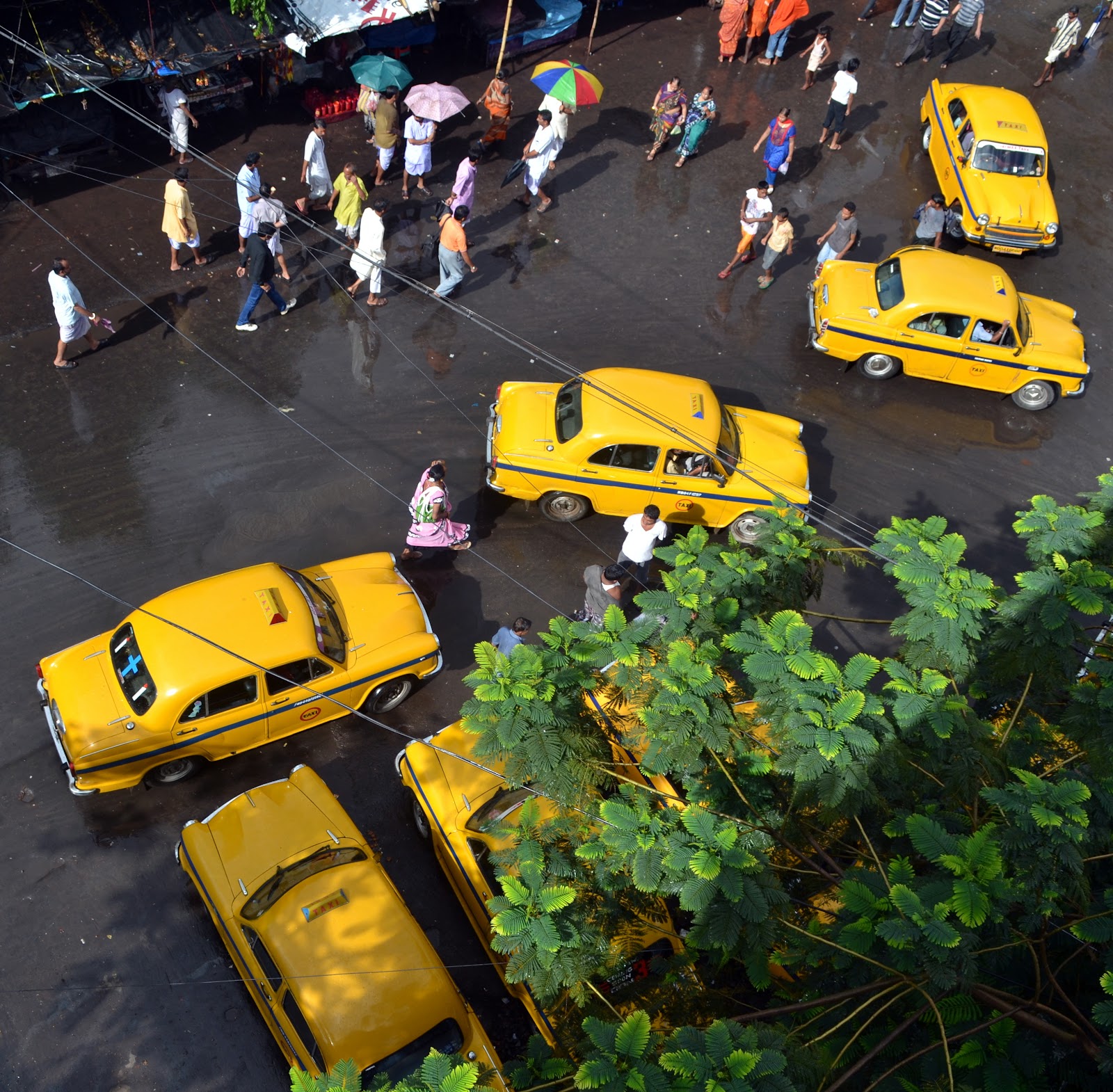
Like the London cabs, the yellow cabs of Calcutta (now Kolkata) also are a legend to the great city. Every cab and the driver have a story. Day before yesterday, I had to travel from North to South at Calcutta and I was talking to the elderly driver of the taxi, Bhupen Singh. For more than 20 years, he had driven a private car of a corporate head, who after his retirement went back to Bombay (now Mumbai) and offered Bhupen to go with him. Bhupen was attached with this city and wanted to stay back. The retired corporate man gave him some money and organized a bank loan for Bhupen to buy a taxi. Now, Bhupen is a proud owner cum driver of his taxi and is probably one of the most reliable and decent persons I have met. He along with three of his friends after months at Hazaribagh jail (for being a part of Jayaprakash Narayan’s movement in Bihar), were released with a payment of Rs.60/- each for the labour which they had given during their time in captivity. This was the month of September or October, but time for Durga Puja. The 04 young men sometimes in 1972, decided to go to Calcutta with the Rs.60/- and see the Durga Puja celebrations. The 03 friends returned to their village in Bihar, but Bhupen had already fallen in love with Kolkata and decided to stay back. Today, he has bought an apartment for near South City Mall for his family and his 26 years old son works for an IT company. Bhupen is proud that his children are more fluent in Bengali language than Hindi. Bhupen can be contacted at 9331374031.
Calcutta, like many of the cities of the world is a destination of opportunities and many youths come here to live their dreams. Till the time they do it sincerely and honestly, the city will remain a better place to live in and visit. Unfortunately, the picture is not as rosy; there are people who want to be rich overnight by cheating others or by irresponsible actions. Recently, as I had reached the Sealdah station early around 6am by Darjeeling Mail, there were several yellow taxis, but hardly any to serve the passengers in the queue. A policeman was running around the place to force the taxis to serve the passenger queue, the taxi union members were sitting idle at the pre-paid taxi booth and a bunch of drivers were trying to woo the passengers in the queue asking for double fares. The issue did not end here.
I am not always comfortable in big city ambiances and I had to deliver a ‘Rakhi’ at a place, of which I had a written address, before I could reach my place of stay. The yellow taxi driver seemed to be a sober and friendly man and when I requested him to take me to the said address as I was not well acquainted with that particular part of the city. Immediately, he did something with his meter which jumped units. After I reached the said place and asked for the printed receipt, he said that his paper was finished. I asked for the rate card, he said as the rates have changed, I have to pay him 50% extra after doubling the Rupee numbers shown in the metre. As this was a remote area, there was hardly anyone in this morning hours to enquire. I paid him. As I reached the contact person, who lived a little inside from the motorable road, I understood I was wickedly cheated. I remember a part of the taxi number WB ? E 7379. I was not unhappy being cheated, but I was worried to where this great ‘city of joy’ was leading to, a city which boasts of being one of the most friendly cities in the world today. 


Tuesday, November 29, 2011

River Karala and Jalpaiguri


Yesterday, when the people of Jalpaiguri Town woke up, they found thousands of dead fishes floating in the river Karala.
I remember a young man from Jalpaiguri, who was then completing his tourism course with North Bengal University, visited my office quite often. He was loud in his comments and proud about his Jalpaiguri town; his regular comment was as follows:
“What River Tames is to London, River Karala is to Jalpaiguri. This is the only city of India, which can be compared with London”.
I had spent a major part of my childhood in Jalpaiguri, the ancestral house of my mother, located next to the Karala River, just opposite to the Jalpaiguri Jail field, a large wooden house, high up on 08 huge Sal  (Shorea) logs, which even withstood the heavy floods of 1968 and 1971. There was a boat which was tied at the river just after a small backyard garden (almost wild) and our favourite place for night picnics. As children, we often explored till the mouth of mighty Teesta River in that boat and sometimes in the opposite direction to the Rajbari (King’s palace). On the opposite bank was the Dinbazaar. Then there was a regular flow in the river and I remember there was atleast 02 community cleaning of the river.
I had no idea where the river originated from, but there were stories from my grandmother that Devi Choudhurani often used this river for her movements. The living river was the proof of the good quality life of the people of Jalpaiguri then. My Grandfather being a freedom fighter of his times, saw good number of friends who were dedicated to the development of Jalpaiguri and her people. There was a living culture for education, health, dance, music and business. I often found it more lively than Siliguri then. With my Grandfather I often visited his friends and relatives at Lataguri, Kathambari, Takdah and sometimes Bhutan. My Grandmother’s father often visited her from Rajsahi in East Pakistan (now Bangladesh) with good Simul cotton and sweets. All the journeys had crossing of several rivers and life with livelihood along the rivers.
Gradually with time our connectivity the rivers have almost gone. We just look at it as a line of feel good, but often forget that these water networks still helps to keep the good health of this earth, provides us with the sweet water supply and inturn food for all living beings on land. We often try and create hurdles for free movement of our rivers through dams and ducts, and do not allow the complete flushing out of all pollution from the land. It is time when we have to think beyond beautification of out river banks, building bridges, covering the river banks near cities to built housing colonies and slums and dumping daily household wastes in the rivers (forget industry, corporate and medical wastes). It is time when we have to think that these rivers, however small or big or ugly they may be, they are the mother of our lives.
The Jalpaiguri incident should be a lesson for all of us. Let every town and village take ownership of their rivers and run community programs, regular volunteering programs from the children, to the working class to retired elders, and establish connectivity with their rivers.

Wednesday, March 2, 2011

Xuan Zang’s Maynaguri, a lost trade and culture hub of Southeast Asia

Millions of Indians have joined the queue since last evening to please Lord Shiva across the country. on the occasion of Shiva Ratri.  
This has been a tradition with the Heritage Jalpesh Temple of Maynaguri from time unknown. The 10 days Jalpesh Mela (festival) inaugurated by the District Magistrate of Jalpaiguri District, Bandana Yadav yesterday will  conclude on the 12th of March, 2011.
Xuang Zang or Hiuen Tsang, whatever we call him is one of the greatest foreign travellers to India, who as a Buddhist Pilgrim has left some of the best historical records for the Indian subcontinent on the trade and cultural routes of those days. The glorious past which we boast of today was documented by this great traveller and we all from this subcontinent will be ever grateful to him. Several persons, starting from Aurel Stein, Alexander Cunningham or author Sun Shuyun and many others discovered and rediscovered Xuang Zang’s travel routes. Some areas still remain grey and one such area is known as Maynaguri, a part of the legendary Bengal Dooars of the British India and a small isolated kashba, almost lost, waiting to be rediscovered.

Venerable Shilabhadra, a superior from the Nalanda Mahavihara (University) had dreamt of the arrival of the great traveller from China and he knew that it is because of Xuan Zang the ‘Holy Law’ will spread far and wide. Not only the ‘Holy Law’, but many stories of kings, people, monasteries and rivers spread far and wide. One such story is of the River Karotoya, which flows like a small stream today, was once a major river that came down from the Himalaya and met Jamuna (Brahmaputra).  After Nalanda, Xuan Zang visited the Sompura Mahavihara and the great city of Mahasthangarh, both now in Bangladesh, the ruins of the later beside the River Karotoya.


As he travelled up the Karotoya towards Pragjyotishpur (the present city of Guwahati in Assam), he passed through this busy hub which connected the Silk Route in Tibet, which still has its traces at Deomali in Maynaguri. This area was then the border of the two great Kingdoms, Pundravardana and Kamrupa, and the traces of the unbelievable nature then described, can still be found as the Gorumara National Park. This was the place which witnessed the meeting of communities of Austric, Mongoloid and Dravidian origin. The cultural traces can still be found in the living temples of Jalpesh and Jatileswar temples and the ruins of Bateswar temple and Sadarkhai. With all the living and the ruined stones of architecture, Maynaguri is a living archaeological museum.


As traders travelled from the high Himalayan mountain trade routes to the sea (Bay of Bengal), the south of the legendary ‘Silk Route’, so travelled the several religious philosophies and music. With time Maynaguri became the seat of various folk music forms and different religious faiths, the roots can still be felt in this sleeping kashba of today.  The natural, cultural & historical evidences on the Xuang Zang’s trails at Maynaguri can be experienced even today in bits and pieces. The elaborate Jalpesh Mela, to be held between 3rd to 12th of March this year, which sees the assemblage of hundreds and thousands of pilgrims and travellers every year is the proof of the living heritage.


In the year 1866, J.Tweedie, Deputy Commissioner of Western Dooars carried out his administrative works from Maynaguri. In the adjoining area of Domohoni, the headquarters of the ‘Bengal Dooars Railway’ was established in 1880 on 800 acres of land, 210 living quarters for railway men with J.A.Polwhel as the first General Manager. The enthusiasts can still find the abandoned Railway Heritage Pride. The quarter in which Polwhel lived can still be seen and the school established in 1892 in the railway area has been named after him.    


Today also Maynaguri stand as a hub for traders from Bhutan and Bangladesh, the seat of Lord Shiva and a major attraction for tourists to the Dooars.
Note: Do not forget to send your travel stories to the Editor through email to atishdipankara@gmail.com.
Chautare has decided to award the best rated stories sent by travellers and uploaded by the editor on this blog with the ‘Xuan Zang Traveller Award’ every year on the 15th of April. The readers have to rate them with A, B, C or D and mention their comments with full name and email addresses.
So friends, lets meet at the ‘Chautare’.