East Himalaya

Showing posts with label Tripura. Show all posts

Saturday, August 24, 2013

Messengers of Peace in India’s Northeast – Part 01

The 03 days Indo-Bangladesh Border Meet (Tripura Sector), which is 82nd of its kind will be ending today at Agartala. Tripura, connected by road, rail and air with the rest of India is probably one of the remotest and less known states of the country. Like India’s Northeast, the border Internationally is much more than the border with any state of the country. Among the seven sisters and one brother of India’s Northeast, Tripura has the least exposure with the country, the indicator being the ‘tourism presence’. Like the rest of Northeast India, Tripura too had her share of the insurgency, but with development and good governance taking the front seat, we hardly hear about the same now.

On 21st of August, 2013, while inaugurating the 03 days Buddhist Convention at Venuban Vihara, the Chief Minister of Tripura, Shri.Manik Sarkar said that there needs to be more action from the Buddhist Monasteries to stand beside the people, who are poor, downtrodden and isolated, and condemn any move which intends to divide the state of Tripura through violence and misguidance. Being one of the longest serving Chief Ministers of the country and being associated with the CPIM (Communist Party of India-Marxist), it was almost unexpected that a communist leader of his stature would attend a religious meet. He made it very clear that his goals as a communist is not very different from that of Lord Buddha’s Teachings, where priority is given to the sufferings of human beings and lead the masses towards enlightenment through a democratic process.

With a similar dream, Dr.B.R.Ambedkar, the architect of the Indian constitution asked several downtrodden and neglected Hindu communities, suppressed because of cast culture of the Hindus, to convert into Buddhists. Those who have been deeply involved with Indian culture understand that there was no religious system in India and Dhamma was a way of life for the people to follow as preached by different TEACHERS. Hence the teachings of Buddha has always been very relevant to all periods, mainly it has become more important in the modern and global age, when people are more self centred, consumer priority and least patient. The time to bring back the values of monastic education, the first form of organized education given to the world through the 05 great Universities or Mahaviharas: Nalanda, Sompura, Odantapuri, Vikramshila and Jaggaddala, all from the Eastern Indian subcontinent.
Tripura has recently provided some priorities to the development of tourism, after achieving great results in the fields of agriculture, roads, use of IT, alternative energy and other basic people’s development. Inspite of the 30 years of communist Government in the state, religion has been the core of the society of Tripura. The heritage left by the royals are getting priority as we see in the role of State Museum being shifted to the palace, a ring road being planned around the lake that houses the Neer Mahal to stop the tendency of encroachment of lake adjoining land in and out of water, the maintenance of the Tripurari Temple etc. 

The major move of opening up more trade borders with Bangladesh is a positive move. The addition of making these trade borders as model tourism gateways to India will help further to nurture the ‘peace process’ which has begun. In Bangladesh, when Cox’s Baazar, Chittagong Hill Tracts, Mainamoti Buddhist Ruins, Sitakund etc are already popular tourism sites, it will be easier for Tripura to combine the popular tourism sites like Unokoti, Debtamura, Pilak and Boxnagar Buddhist Ruins, Neermahal, Trishna etc with Bangladesh sites. The option for Indian domestic tourists, as well as foreign tourists visiting India, it will be convenient for Tripura to use Chittagong as a base then any Indian city like Guwahati or Kolkata. India must look forward to Sabroom as one of the Gateways to India for the purpose of Tourism.  


Tuesday, March 22, 2011

Tripura, this time...

While browsing through the old British documents in regard to the natural history of the present India’s Northeast, I came across the mention of the Surma Valley as one of the most naturally diverse regions of British India. Later tracing the roots I found out that the region mentioned is the Sarma River and Raima River region, following into the Gomti River and continuing into the Chittagong Hill tracts in present Bangladesh. Ajoy and I had then done this expedition on the Gomti River and were left wonderstruck with the nature and more with the huge sculptures on the stones of the gorges of Gomti. This was love at first sight with Tripura and the travels to Tripura continued with excuses and invitations to come back everytime.
This time it was a trip to plan ecotourism initiatives for Tripura, North to South, giving people a chance to realize and revive their natural history. 
Jeopardized Jampui Hill
India’s Northeast consists of 07 sisters and brother, the least known to the country and world at large being Tripura. Landlocked on three sides by Bangladesh and the Indian states of Assam and Mizoram, Tripura like many other Northeast states has observed settlement of political, communal (ethnic clashes) and economical refugees.
On the 17th of March, 2011, I was on a survey visit to the Jampui Hill in North Tripura. Based out of Vanghmun, I was to cover Tlangsang, Sabual and Phuldungsui to explore the possibilities of village tourism in these areas. Working at day and travelling at night during this period was an experience of the mystic ambience created by the super-moon (the largest moon seen in the last 18 years). Also what worried me most was the burning for zoom cultivation (slash and burn) and I could see the forests burning at night and the charred hills at day.
The zoom culture all over the Jampui Hills for agriculture, for Government subsidised coffee, betel nut and banana plantation almost denuded the hill tops with rich wilderness. There was an immense use of fire wood for cooking fuel and this loss of cover resulted to acute water crisis all over the Jampui Hills. This dry season existed for 05 ton 06 months a year and is in the increase. The problem is so acute that all water harvesting systems have fallen short.
This crisis has been doubled by the drying of orange trees, the economical backbone of the Mizo people living in this part of Tripura. As per one of the Mizo Youth Association members from Sabual it was known that the village earned a revenue of about 46 lakh rupees during the orange harvesting season, but now the revenue has dropped by almost 70%. I suggested that let there be an annual Orange Festival during mid-November, an ecotourism and livelihood festival to promote peace within the Mizo, Reang and Chakma communities in and around Jampui Hill. Through this initiation, homestays and community lodges to be introduced in this area. An Assam-Tripura-Mizoram, three sisters circuit to be also promoted through this initiative.
If these initiative is not taken and the people be motivated into nature conservation and sustainable livelihoods, they would soon become environmental refugees.


Ruined Reangs
While returning from Phuldungsei, it was already dusk and while crossing through Sabual, the sky was dark with black smoke from the burning of forests below. There was a significant local crowd watching from the top and they confirmed that the burning was for zoom cultivation. I exclaimed within myself ‘what an enormous forest fire, the animals would all die’. The next day the news was even worse, 16 people were burnt to death and 25 serious with burnt injuries from the village of Gochirampara-Naisingpara  under Dasda block of Kanchanpur, the fire that we saw from the Jampui Hill had gone out of control.
The Bru people or the Reangs of this area fled their homeland Mizoram, following ethnic clashes with the Mizo communities in 1997 and about 30,000 of the Reang people came to stay in 06 refugee camps of Tripura. Whatever little they had were burnt down including their refugee I-Cards. Though the Tripura Government has rushed immediate help, yet a long term global support is required to stabilize this section of the human race.


Unique Unakoti
I had heard from my mother-in-law that before her birth, her parents, who were from Dhaka Bikrampur in now Bangladesh had settled in Dharmanagar in Tripura, where her father worked for a tea garden. From here he went to work for a petrol pump (fuel/gas station) in Siliguri, which he finally owned. I had made it a point to spend some time in this busy trading town of Dharmanagar. The next day I spent at this one and only of its kind site in world, Unakoti. With hardly any traces of its roots, some sculptures seem to be from the 5th to 12th century AD, but the major sculptures seems to be some tribal expressions of the Hindu Gods, Goddesses and vehicular animals (bahan) on stones. Very little is known about these unique sculptures and decided to spend the night in the full moon night, waiting for the spirits of Unakoti to come and tell me the secrets.

This is believed to be a Shaivite site (dedicated to Lord Shiva) and local priests who helped pilgrims to offer prayers are mostly Deb Burmans. I decided to join a villager, Dhuti Nandan Deb Durman to walk to his Chinibagan village (the nearest village from Unakoti or the guardians of Unakoti) and walk further to Kailashahar. A wonderful walk through the bird rich forest trails, with encounters with sought after trogans, paradise fly catchers, racquet tailed drongos etc.

Threatened Trishna
After I reached Agartala, I thought of enjoying a fish meal at one of the famous pice hotels. They still continue to sell turtle meat, when I first visited Agartala it was Rs.35/- a plate, now it is Rs.350/- a plate. It just reminded me of the discussions the other day at the Chief Wildlife Wardens (CWLW) office on the sale of turtle meat at the fish markets and their strong lobby to continue selling the same. Immediately after lunch I visited the Netaji Market only to find turtles being sold openly. The price range was between Rs.800/- to Rs.1000/- a kg of turtle meat. My friend Kaushik confirmed me that there were 02 schedule 01 species being sold Indian Mud/Flap shell turtle (Lissemys punctata granosa) and the larger one being Peacock soft shell turtle (Aspederetes/Trionyx). I remember the CWLW had told me that these turtles were from Bangladesh.
Immediately with my friends Kamal and Kaushik we decided to start an awareness drive among the consumers of turtle meat in Tripura, ‘Kacchap Bandhu’. With our little capacity we bought a small Indian Mud shell turtle weighing about 02 kilos and motivated our driver to drive us the same night to Belonia. We looked after the female turtle for the whole night to make it strong and next day we started for Rajnagar, the entry to Trishna Wildlife Sanctuary.

The approach road of brick was cut at different places and the reason was to stop hand carts to enter in the forests to bring firewood and bamboo in bulk. The exercise of illegal extract of the above produce still continues with some difficulties for the people who now carry them in bicycles and head loads. Initially a lot of cashew orchards had replaced the forests of Trisna, but the Forest Department is reclaiming back the same with acute livelihood concerns for the huge population who live around the sanctuary.
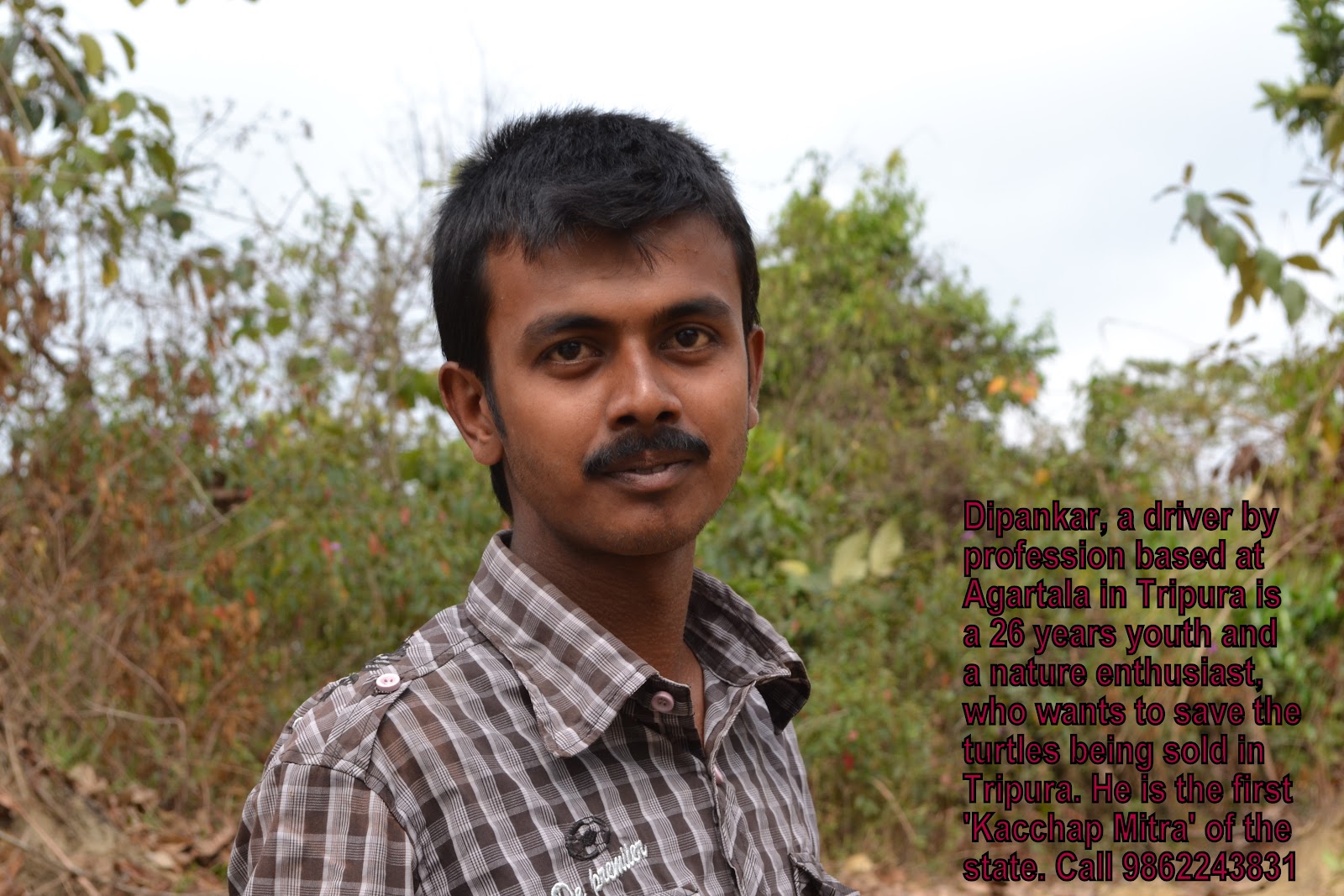
While proceeding towards the water body near the tower, we met Srichandra Tripura from Marak Busty and Helal Mia from Muslimpara. They confirmed the fact that more than 2000 cattle enter the park everyday with every family around the park having 04 to 05 cows. With lot of enthusiasm our driver friend, Dipankar took the turtle to the water body in wilderness and with great wonder observed the turtle swimming freely in the waters. He promised to bring back a male with the next tourist group and release it in the same water so that the female can get a company and grow a family. Hence, he became the first ‘KACCHAP MITRA’ of the state.