East Himalaya

Sunday, March 8, 2015

The Last RUNNER

A poster from Snehargo and copyright with Association for Conservation & Tourism (ACT)
Tshering Dukpa was the last dak runner between the Buxa Duar Post Office and Buxa Road Station, next to today’s 28th Mile village. The railway connectivity, which started as the Bengal Dooars Railway under British India, continued in this area till about 1981-82 as part of Northeast Frontier Railway. Also Indian Postal service network then, one of the largest and most far reaching to the remotest areas of the country had reached Buxa Duar and it was Tshering Dukpa’s duty to take the Dak (mail) between the last Railway Station to the mountains of Sinchula Range. There was a time when the Post offices were the only connectivity to the world outside through telegrams, letters, banking, telephone and free advice (from Postmasters, most of the time who were the only educated person of the area where they were posted), but almost all of these services are endangered or extinct today.
After the Duars War between the British East India Company and the mighty Bhutan (Dukpa) King, the British in their imperialistic and trading interest took over the 18 Duars, the then rich revenue source for trade between the Rice Route terminal in the Chittagong area and the Silk Route terminal in Bumthang area. These were the land routes which started from the last navigable points of the Mountain Rivers, which went and met the Brahmaputra. The Dukpa community then would have dominated the ruins of forts now found in Chilapata and Chiknajhar in North of West Bengal and Bodoland in Assam. The ruins of the fort of Buxa now, were no exception then. The architecture, food, dress and archery of the villages in the area, are still proofs of the Dukpa connect.
Coming to the Post Office of Buxa Duar, this was the Commandant quarter, which was part of the Division office in 1879, on the cantonment road. This was post the 1865 Duar War and Sinchula Treaty. The Dukpa villages stayed on in the British India territory. The area gradually flourished, mainly in the foothills and places like Kalchini, Hamilton, Samuktala, Kumargram etc came into prominence and till late they were known for Tularam Yadav, the transporter, Damchee Lama, the Director of Hillman Trading Company and Chiranjee Lal Chamaria, the planter and many such great personalities of Central Dooars. Tea Gardens developed in the area, the ones owned by Britishers were known as ‘Saheb Bagans’ and the ones by Indians as ‘Babu Bagans’.


It is because of the Tea Gardens, Hasimara was the main Air Terminal, which is presently a Defence Air Terminal under Indian Air Force. I often heard about the legendary Bhatpara Central Hospital, where the Dakota Medical Cargos landed at Achapara to renew medicine stock for the planters and administrators. Even a generation ago, the legend about the medical retail shop at Banarhat, established by Sailesh Chandra Chowdhury, Mukherjee & Chowdhury Brothers, was known to have medicines, which was even not available in Kolkata. Jainti, Raidak, Rajabhatkhawa, Bhutan Ghat, Raimatang and Buxa Forests were well known hunting grounds. The planters, administrators and several business men were given permit to hunt even till the late 1960s.

Alipurduar, very recently from being a sub-divisional town has transformed to be the District Headquarters named after this town. This was cut out of Jalpaiguri and most of central Dooars is now under Alipurduar District. Post Independence, the evolution was on a completely new track. Buxa Fort gradually lost its importance with time, the fort converted as jail for Indian Freedom Fighters, became the Tibetan Refugee Camp between 1959 to 1969. After, the Dolamite and Lime mining of the Buxa Hills, headquartered at Jainti was stopped to create the Buxa Tiger Reserve, intellectuals from Alipurduar to Kolkata kept visiting Buxa Fort or Buxa Duar, mainly because of Hari Shankar Thapa, a man who stayed at the fort and kept alive the light of Indian Nationalism and Indian Freedom Movement.

His nephew, Tara Shankar Thapa, started with the first Homestay of Dooars at Rajabhatkhawa, known as Gracilips. He and his wife still continue to run this homestay without compromising on the authenticity. Even Hari Shankar Thapa’s son has converted the house into a homestay. An interaction with him will remind the older generation who knew the enthusiastic Naya Bayun or popularly Joe. The major stake today for the people in the western part of Buxa Tiger Reserve is Tourism, all developed in a very local style, because of the lack of other respectable livelihood or even patronization from the Tiger Reserve administration.
The Buxa Tiger Reserve administration is mostly against any improvement in the lives of the villagers living in the area, even the Dukpa villages, which have been there for time unknown. I remember a Field Director, who on a Sunday Church day chopped down the orange trees of the orange orchards of the particular Hill village, which was the only livelihood of the people. This livelihood was so ancient; that the foothill area, where the oranges were brought in the season, came to be known as Santrabari (Santra in English translates as Orange). The impact was so extreme that a rich patch of canopy forest which connected Buxa with Chilapata through Poro was lost overnight.

This kind of high handedness still continues. We have seen how Field Directors, who had counted 25 plus tigers at the Reserve has become an expert on Big Cats, internationally. Many of the experts today say that there were never so many numbers since the Tiger Reserve was formed. The villagers challenge that there is not a single Tiger, or else there would be cattle lifting. Millions of dollars have come to the administration to ensure micro developments for the communities living in the Tiger Reserve. Since, 2010, a notice has been given by the Tiger Reserve administration to most of the villagers in Western side of Buxa Tiger Reserve to vacate their villages against Rs.10 lakh per family. The plan also includes uprooting the Dukpa and other hill communities from the Hills and settling them in the plains besides the roads has been provided as a solution by the Forest Minister and the Wildlife Board, as announced in the media recently.
If you have read this article and feel that you should step out from the comforts of your four walls and live for weeks with the BTR villagers, to understand them and stand beside them, the time to now. The same request is to the members of the Wildlife Board too.
My connect with Buxa and Central Dooars is not very old and authentic like many others who have been born and brought up in the area. My intimacy started in the late 1980s as a Research Assistant for Tiger Reserves, followed by the first Guide Training Program at Jainti (probably the first ecotourism guides in West Bengal), then Rural Tourism motivation programs for villages and finally, the most intimate is through the CDEF (Central Duars Eco-Fest), which is more recent.


Thursday, February 26, 2015

Bhutan, India, and Nepal agree on a regional cooperation framework for conservation and development in the Kangchenjunga Landscape

Press Release: 
(25 February 2015, ICIMOD, Kathmandu, Nepal)


Participants at the 3rd Regional Strategic Consultative Meeting for the Kangchenjunga Landscape stressed the need for greater collaboration to protect the region’s rich biological and cultural diversity through strengthened partnerships and increased participation of people in the landscape.

About 60 representatives, including high-level government officials from Bhutan, India and Nepal — the three member countries of the Kangchenjunga Landscape Conservation and Development Initiative, the International Centre for Integrated Mountain Development (ICIMOD), and strategic development partners Gesellschaft für Internationale Zusammenarbeit (GIZ) and the Austrian Development Agency (ADA), met for the conclusion of the one-and-a-half year preparatory phase of the Kangchenjunga Landscape Conservation and Development Initiative (KLCDI). The meeting, jointly organized by the Government of Nepal’s Ministry of Forests and Soil Conservation (MOFSC) and ICIMOD, was held from 23 to 24 February at the ICIMOD Headquarters.

PR_Group-photo1_low.jpg

During the meeting, partners consolidated the activities of the initiative’s preparatory phase and apprised country delegates of the outputs and content of a draft framework for regional cooperation, which takes into account the need for greater collaboration across borders, as well as opportunities for socioeconomic development at the landscape level. “Having taken these key steps, we can now move into the implementation of coordinated activities for the conservation and sustainable development of this important landscape”, said Nakul Chettri, KLCDI Programme Coordinator.

”It is very important for us to generate on-the-ground impacts to support adaptation and resilience among the communities living in the Kangchenjunga landscape”, said David Molden, Director General of ICIMOD. He also encouraged the initiative partners to use the knowledge and data resources ICIMOD has made available, in particular for geospatial and cryosphere analysis.

The three member countries proposed an area of about 25,000 km2, covering parts of eastern Nepal, Sikkim and the northern part of West Bengal in India, and western Bhutan, to be included in the Kangchenjunga landscape, one of the seven transboundary landscapes identified by ICIMOD with its regional partner countries for prioritizing conservation and development programmes in the Hindu Kush Himalayan region.

The landscape is one of the richest areas on earth in terms of plant and animal species. There are 19 protected areas in the landscape covering 30% of the total area. More than 4,500 species of flowering plants have been recorded from the region, and there are more than 400 varieties of orchids and 40 varieties of rhododendrons. This region is also home to charismatic wildlife species such as the snow leopard, musk deer, red panda, Asian elephant, one-horned rhinoceros, and Bengal tiger. Many of these wildlife species are endangered and, if proper conservation mechanisms are not put into place, vulnerable to extinction.

”Nepal is privileged to be part of this transboundary landscape initiative, which will provide a platform for the collaborative efforts needed to address regional issues such as human-wildlife conflicts and the illegal trade of threatened species”, said Sharad Chandra Paudel, Secretary at the MOFSC.

Dr JR Bhatt, Advisor at the Ministry of Environment, Forests, and Climate Change, Government of India highlighted binding factors for people living within the Kangchenjunga landscape: the commonality of their cultures and their respect for nature. ”We need to shift to a more participatory approach and involve communities so that they have more ownership and responsibility for managing their biodiversity resources”, he said. He also emphasized the strength of the landscape approach being applied in this initiative, and the opportunities it would provide in creating important transboundary corridors to connect not only large and charismatic wildlife species, but also many small mammals and plant species.

Reaffirming the commitment of the Royal Government of Bhutan to the Kangchenjunga Landscape Conservation and Development Initiative, Dasho Tenzin Dhendup, Secretary at the Ministry of Agriculture and Forests said, ”Biodiversity, wildlife, and nature do not recognize political boundaries; therefore, all the countries in the Kangchenjunga landscape need to work together to ensure that we can hand over a well-conserved landscape to our future generations”. Mr Dhendup also highlighted the need to use new and scientific knowledge in conservation and development efforts, but not without forgetting the traditional knowledge of the people in the landscape.
Book-launch_Animesh-Bose_low.jpg

”The regional framework for cooperation prepared during this meeting will be the basis for implementing the subsequent phases of the Kangchenjunga Landscape Conservation and Development Initiative. Through this collaboration, we will be able to produce positive outcomes”, said Basanta Shrestha, Director of Strategic Cooperation, ICIMOD.

“We need to be innovative in order to adapt to a changing environment”, said Dr Eklabya Sharma, Director of Programme Operations at ICIMOD, adding, “Cooperation in transboundary landscapes like Kangchenjunga provides us with an opportunity to work together to find new solutions to emerging challenges”.


During the workshop, the book Kangchenjunga Landscape Nepal from Conservation and Development Perspectives – published by the Ministry of Forests and Soil Conservation in collaboration with the Research Centre for Applied Science and Technology and ICIMOD – was jointly launched by  Mr Sharad Chandra Paudel, Dasho Tenzin Dhendup, and Dr JR Bhatt.


Thursday, August 7, 2014

Mast Pahari

Devdayal Bhatt runs a small tea shop between Almora and Kasauni. The land from the road to the river belongs to him. More than tea, he loves to treat people with glasses of cold water, which he instantly brings from a water source above his shop. He proudly tells his visitors, drink as much as you want, no where you will get to drink water from source, we still do not use anything to do with electricity. The river water moves our wheels, which helps to move the crushing stones to give our flour. We grow and eat all organic vegetables and pulses, the river water makes everything grow giant size. He takes out a big size onion and said that this also grew in this land here. He proudly said that you can take some of our potatoes; Delhi can never have access to these tasty stuffs. This attitude that our people in the Himalaya comes from being a part of the sustainable society with their food, clothing and shelter, which they receive from the forests, rivers and air around them, supported by a road access and tourism. 


Travelling in the area of Kumaon and Garhwal Himalaya, for a long time, I did not know how to name this attitude, till I went for a meeting at the Wildrift Camp at Mukteswar and saw the organizers of the camp wearing the T-Shirt with ‘Mast Pahari’ printed on them, yes this is the best term, MAST PAHARI. Tourism has started taking a front seat in the entire area with every possible turning, village, river bank or hilltop developing innovative tourism infrastructure like basic camping to luxury camping, old houses or estate homes being converted into heritage tourist bungalows, modern hotel building to resorts, every pine, plum and peach grove added with some tourism accommodation. Most of the regular livelihoods have been complimented with tourism and has stopped several youths from migrating to the so called developed cities in India.
Swami Vivekananda, after his return from America, spent a long time in Almora, where he planned the Ramakrishna Mission. He strongly believed that all the so called privileged people of this country, those who have achieved a more confirmed future compared to their counterparts in remote villages, will be called traitors if they did not serve the millions back in villages, based on whom the confirmed future has been achieved. Tourism in true sense has showed a way. I remember Subrata da, as a bright young urban youth, who could confirm his future in any city of the world, decided to start the first of its kind of camping in Kumaon Himalaya in a then very remote place called Munshiyari. Today, we find so many such youths, who are creating a new future across villages in the Uttaranchal Himalaya, where they feel that the villages they work with are part of their own. They go beyond tourism to create social and environmental development in their area of work.

The Governments at the states or centre still fail to recognize such efforts. Instead of appreciating these initiatives, they threaten them with half hearted Government Tourists Lodges, where being Governments, they occupy the prime locations. When the Wildlife Sanctuaries and National Park management are handing over the tourism infrastructure to the private players against a confirmation of enhancing the conservation process, look at KNVN clinging on to locations like the lodge at Binsar Sanctuary, which would have not only brought great revenue to the organization, but also supported the conservation initiative if planned properly and handed over to professional hands. Sorry, this is an example as I was discussing Uttaranchal, but the same stands for all the states in India, including the India Tourism initiatives with ITDC etc.


The time has come to question, that when we have such strong tools like tourism working at micro levels, do we really need these mega projects of Hydro-electric power project dams in our rivers, where we are killing the common livelihoods by killing our river systems, which has supported millions and created civilizations. A tourist likes the luxury of lanterns, then the common electric lights. S/He is more influenced by the local village markets than the urban malls, the local organic food which is preferred over canned and packed food and above all it is the unspoilt landscape which will bring the tourists back over and over again, making the destination another home. Can we deprive the thousands of people, who have lived through generations along the rivers, through this imperialistic policy to finish their livelihood and culture by building dams?
Nainital is the most popular destination in the area. During my school excursion, when I had visited Nainital then, much of it has changed, except the candle shop, which now calls itself ‘The Pahari Store’, a must visit, if you are in the lake. In those days, I could with lot of hardship visit Bhimtal, but recently I was amazed to visit Naukuchia Taal. It is believed that it is only Arjun from Mahabharata, who could see all the nine corners through his enlightened vision. Partha, my friend, who is one of the few Asians to have participated in the White Water Olympics (Slalom Kayaking) had put me on to The Lake Resort for my hospitality at Naukuchia Taal. The Resort’s undisturbed forest contributed to the health of the lake to some extent, but the best part was the bird life and the deer population in the camping campus was extraordinary. 

The MAST PAHARI people, the fruit orchards and holy landscape of Kumaon (Devbhumi) with all the legends makes Kumaon a must visit in the Indian Himalaya.  


Thursday, June 5, 2014

Own a House in Nagaland

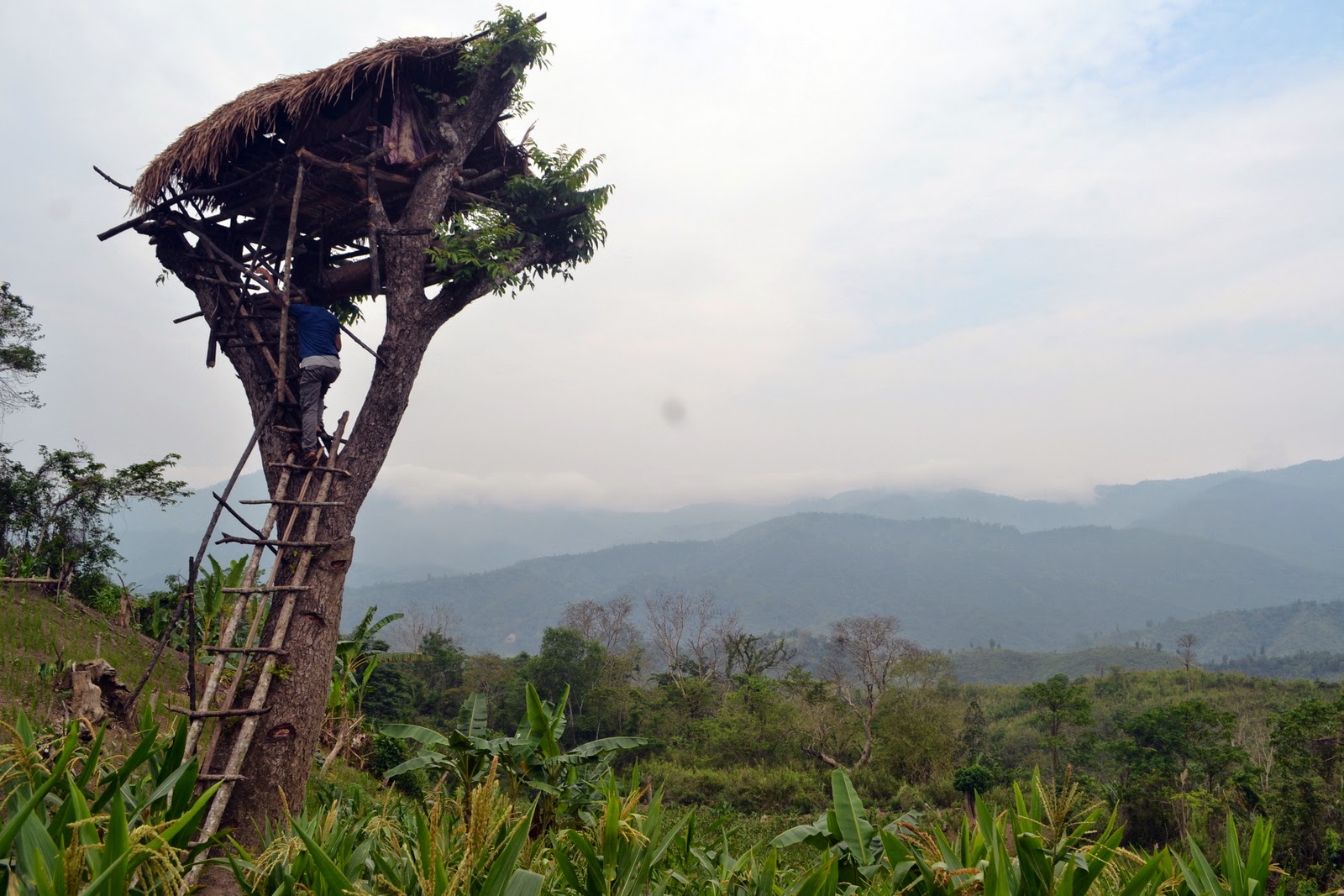
I had posted a tree house photograph on Facebook during my stay in Pangti, Nagaland,  https://www.facebook.com/photo.php?fbid=10152841307263332&set=a.10152676788458332.1073741837.732133331&type=1&theater and there were more than a hundred ‘like’ to the post, probably because of the fact that I had mentioned that you can now own this house with a kitchen with dining cum sitting in the ground floor. These images are from Pangti Village. The Lotha community in Nagaland had built this village more than 600 years ago and as they settled down, they practiced different agricultural patterns. To protect their crops they build field houses, where they live temporary to look after their house. The pattern of the house depends on the wild animal visiting the field. 
The common visitors to this village were elephants, tigers, wild boar, snakes, insects, birds and many other known and unknown beings. Unknown, because many of the people are believed to have seen the pygmy people, who prayed by the special fire stone or Monkhumuv nchu. The Tiger Stone or Mhorhu Etsiphen which is there is meant for measuring the tiger after killing. The largest number of visitors to this Pangti village and some adjoining areas are the AMUR FALCONS, probably the largest single species animal migration known to the world. The number highlight has happened after the Doyung Reservoir was created.


In the meanwhile, because of the reservoir, the rivers became less dynamic and the immediate effect was the huge reduction in fish numbers. The fishermen union President, Zanthunga Shitiri said that our fishing nets now leave the waters and are spread in the trees to arrest the visitors, the Amur Falcons, in as many numbers possible... sometimes so much that our fishermen cannot carry them. At the same time, the ‘slash and burn’ method of clearing for zoom cultivation is fast reducing the canopies in and around Pangti. Lijon Ngullie, a local but enlightened farmer remarked that the low rainfall and the loss of forest after the reservoir had been made, our crops too have reduced and our people have to match the increasing fees of children at school and the growing prices with growing consumer wishes do not have any matching livelihood. And, hence the Amur Falcons.


This was an SOS from our very close friends Ramki and Bano, that Asit and I decided to visit the village. As we heard the Pangti Village Chairman, Vice Chairman Ronchamo Shitini, Vice Secretary S.Wabamo Kikon, we could not believe our ears. Last year with the involvement of the big and International NGOs, Government and several other well meaning individuals, the hunting of Amur Falcons were banned in Pangti, posters were put up and awareness programs were run. Also, promises were made to find out means of alternative income. With the return of the Amur Falcons, the villagers still wait for the promises to be fulfilled. The Chairman clearly said that this year it will be impossible to stop the hunting, we could not fulfil any of the promises which we made on behalf of the several organizations and individuals. The posters will reflect the thought process of the villagers.
The Amur Falcon season is not far away. If everything remains as usual, come October 2014 and they start arriving and lives in and around the Pangti village upto the end of November. All responsible tourists, travellers, nature lovers, photographers and tourism associations, the time has come to respond to the call. Adopt one of the field houses in the agricultural land and compensate the income of the family, earned through killing of the visitors, ‘the AMUR FALCONS’. Come and live a month or two with the Naga Village life, or invite your friends and relatives for a week or more, before you end at the Hornbill Festival between 1st to 7th of December, 2014.
For details, please write to northeast@helptourism.com or call 9831031980.